Work / MaraponeAI
MaraponeAI
One engine, five programs, from the tender to the buyout.
- Type
- AI model
- Status
- Released, 2025
- Our role
- Model training, systems architecture, hosted platform build — with Marapone
- Timeframe
- 2025 — ongoing
Built with Marapone. Built with the Marapone team — they brought the domain and the operational data, we brought the model and systems work. Marapone is a separate company. We built MaraponeAI with the Marapone team; Marapone owns and operates it.
MaraponeAI is the engine the rest of Marapone is built on: a model fine-tuned on the documents that actually run a construction project — drawing sets, project manuals, tenders, subcontractor quotes, RFIs — rather than a general-purpose model asked politely to pretend.
It is Marapone's own model on Marapone's own infrastructure. Nothing a customer uploads is forwarded to OpenAI, Anthropic or Google, and nothing they upload trains anything. That is the part of the original promise that survived; the part that didn't is below.
- Programs on one login
- 8
- Programs on one login
- Third-party AI vendors in the path
- 0
- Third-party AI vendors in the path
- CAD/month to start
- $69
- CAD/month to start
The problem
Every AI vendor selling into construction arrives with the same general-purpose model behind the same chat box, and construction documents defeat it. A clause in a project manual, a cell in a door schedule and a note on a sheet are three different shapes for the same fact, and the expensive mistakes live in the gaps between them.
The other half of the problem is commercial. The documents a contractor puts through a tool like this — live tenders, subcontractor pricing, their own cost structure — are the most competitively sensitive things they hold, and handing them to an AI vendor whose next customer is the firm bidding against them is not a trade most people want to make.
What we built
A private inference stack running models fine-tuned on real construction documents, wrapped in a domain layer that knows a CSI section number from a sheet number, and hosted on infrastructure Marapone operates end to end. No commercial AI API sits anywhere in the path.
On top of it sit eight programs — the pre-award five (Blueprint Auditor, SpecChecker, AI Estimator, Bid Leveler and ScopeGuard) plus a post-award suite (FloatGuard, TradeVet and CostLine) — that hand each other their numbers rather than making an estimator retype them. Each customer's documents are processed in a workspace scoped to their account alone, nothing is used for training, and any project can be exported or deleted on demand.
We changed the model, and said so
Marapone used to sell these programs outright: one price, install it, we walk away. It was a clean promise and the wrong shape for the product. Building codes get amended, rate tables go stale, and the model reading a drawing set is measurably better than it was six months ago — a copy sitting on a laptop from last spring gets none of that. Half of what shipped started decaying the day it was delivered.
So the whole thing moved: Marapone runs the engine, the programs open in a browser, and customers subscribe from $69 a month with every improvement arriving the day it ships. It is a harder business — the renewal has to be earned every month rather than banked once — and it means being straight about the trade-off, which is that documents now come to Marapone to be read. Firms whose contracts genuinely forbid that get a private deployment into their own tenant as an enterprise arrangement, negotiated up front rather than implied by a marketing line.
Technology
Fine-tuned open-weight models, Python, Web app, Stripe, Hosted infrastructure
The Construction Suite
Drawings in, awarded subcontract out, nothing retyped.
A bid moves through five distinct readings of the same pile of documents, and each one is a job somebody does badly at 11pm because there isn't time to do it properly. Measure the drawings. Check the spec book against them. Price it. Level the sub quotes that come back. Review the scope before you award.
The suite is one program per stage, in that order: Blueprint Auditor takes the quantities off the sheets, SpecChecker finds where the manual and the drawings contradict each other, the AI Estimator turns quantities into a defensible number, Bid Leveler normalises a dozen quotes onto one scope, and ScopeGuard catches what the winning sub excluded. Each stage hands the next one its output, so the takeoff becomes the estimate and the levelled position becomes the subcontract scope.
All five open in a browser tab on any machine — nothing to install, nothing to licence — and the jurisdiction they price and check against is a data pack rather than a hardcoded assumption. Toronto and Ontario are the deepest, because that is the ground the team came off.
- Programs, one continuous job
- 5
- Programs, one continuous job
- Plans, $69 to $1,199 CAD/month
- 5
- Plans, $69 to $1,199 CAD/month
- Unlimited use — no credits, no overage
- ∞
- Unlimited use — no credits, no overage
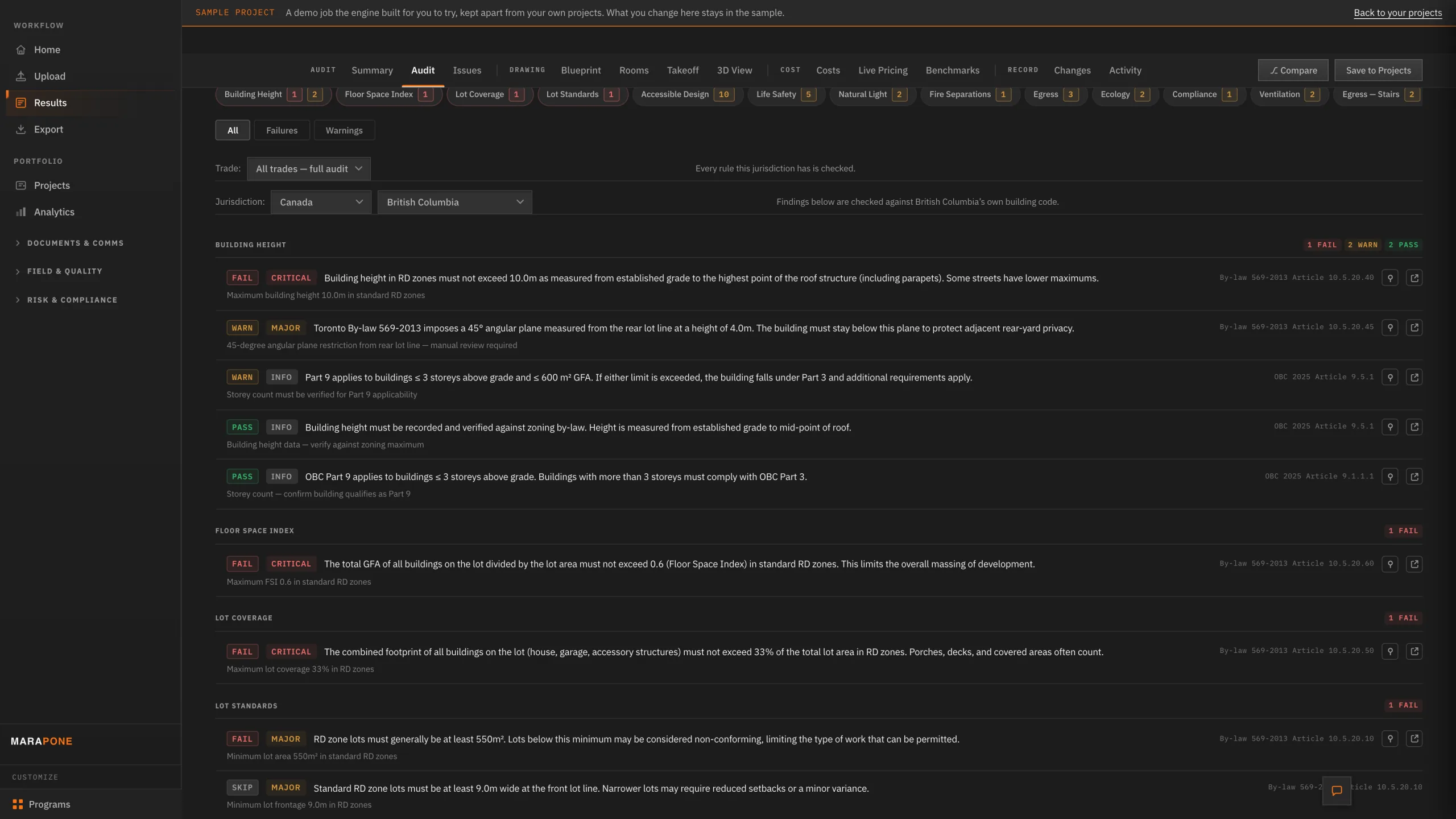
Code audit 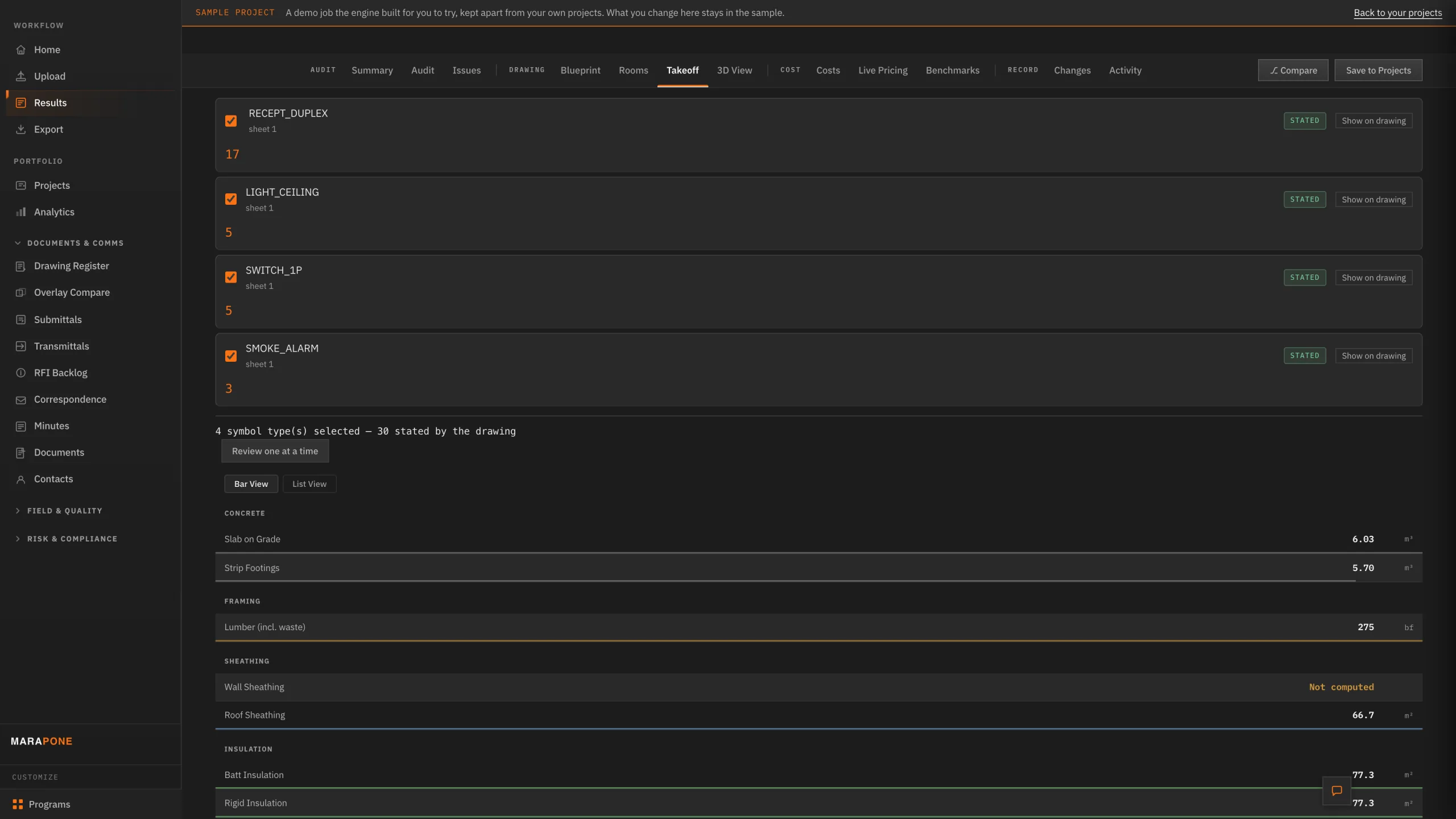
Quantity takeoff 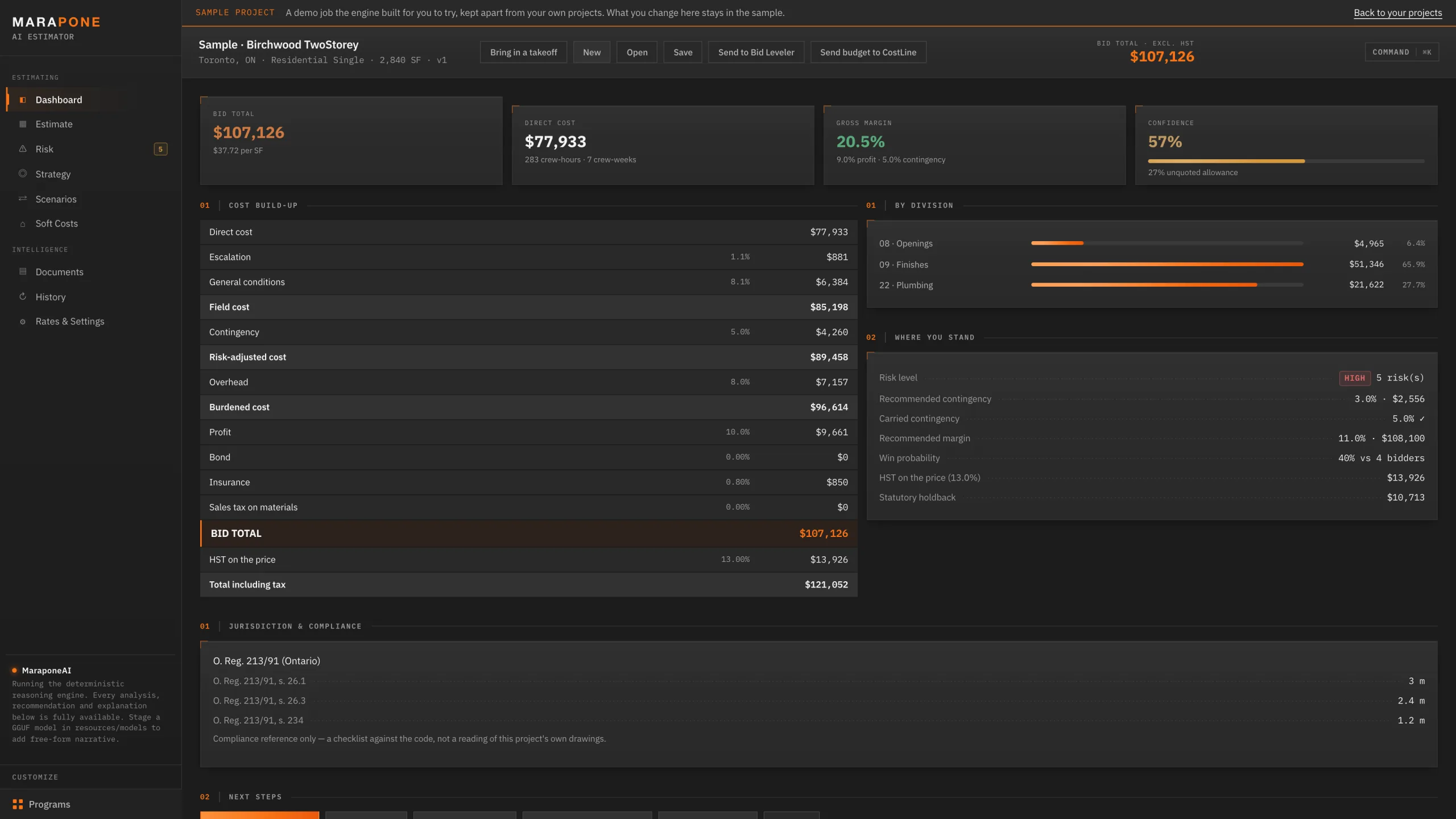
Cost estimate 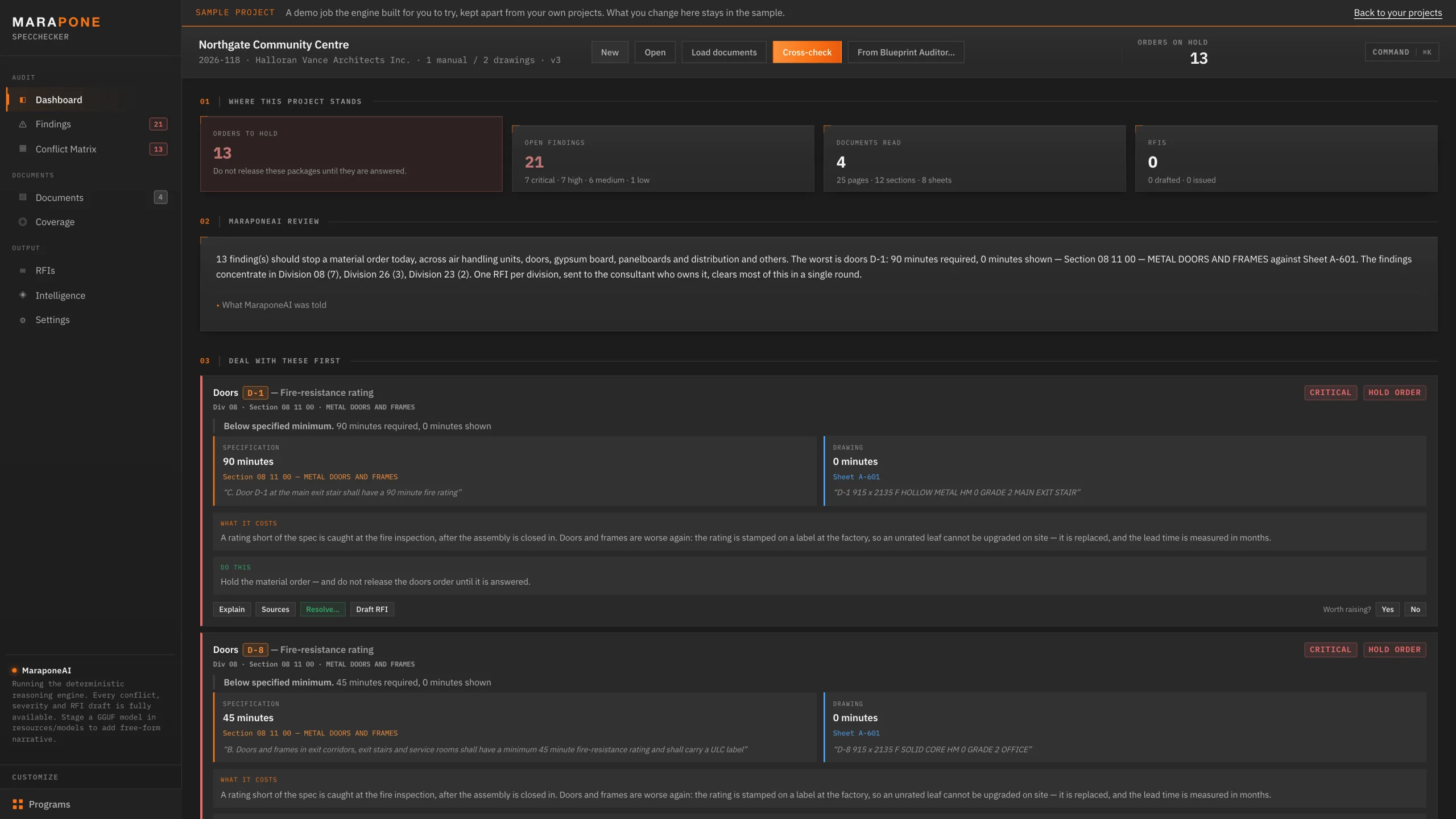
Spec conflicts 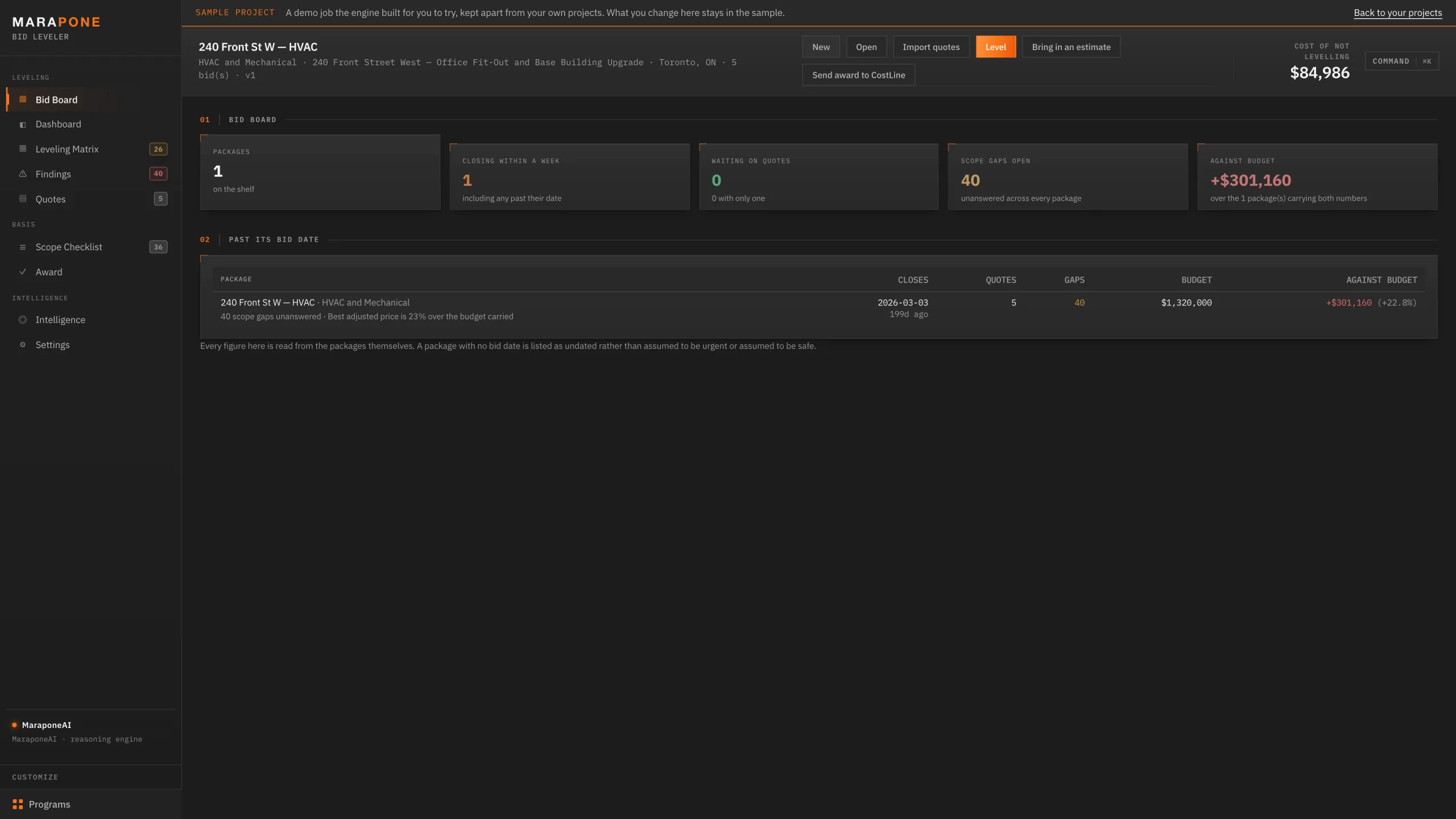
Bid levelling 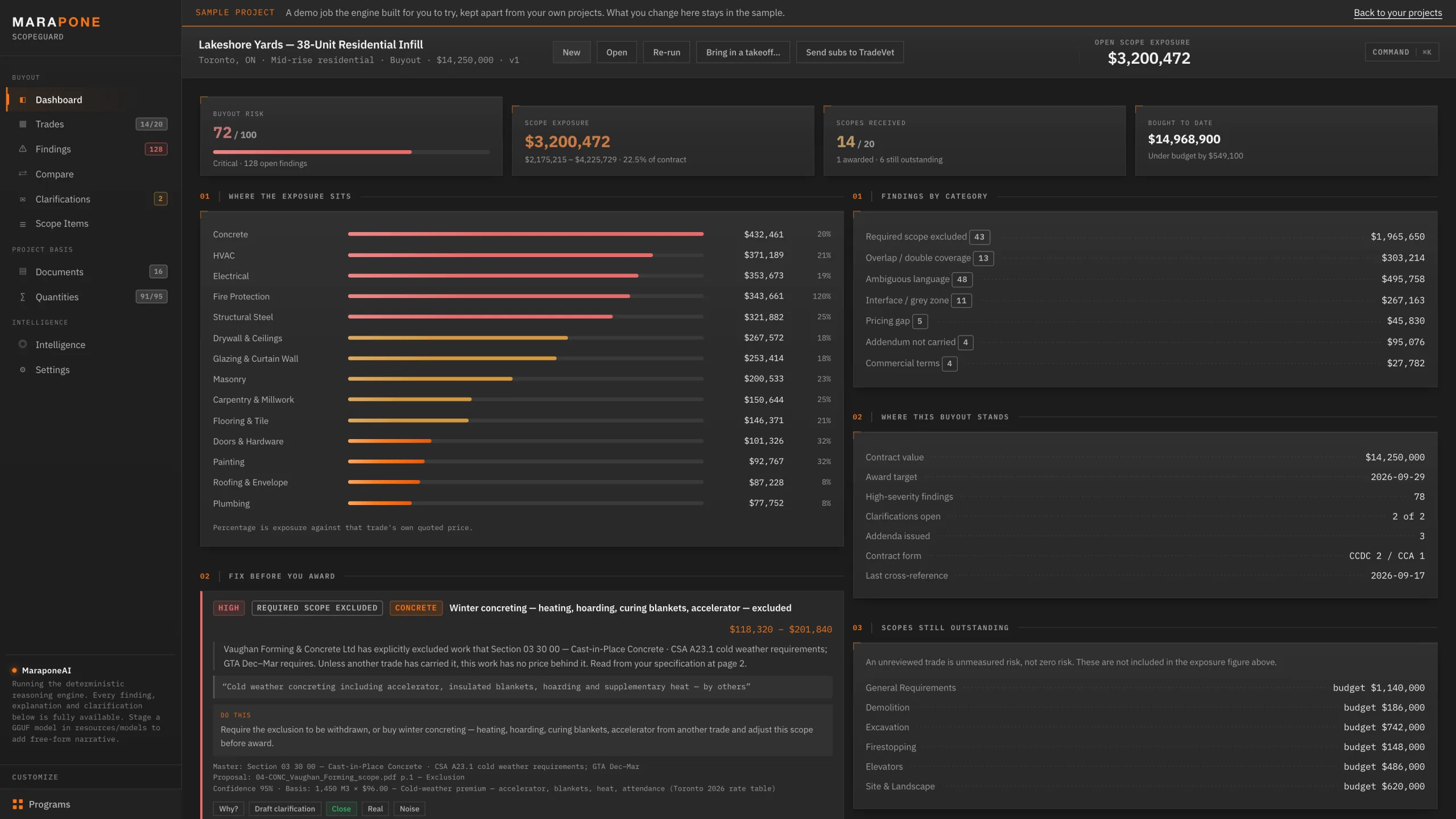
Scope gaps
Programs in this suite
Blueprint AuditorTakeoff, code review and tender risk, off the drawings.Included from Field, $149 CAD/month · 7 days free
- Audit tools in one pass
- 8
- Audit tools in one pass
- CAD/month, 7 days free
- $149
- CAD/month, 7 days free
- Per-drawing fees or AI credits
- 0
- Per-drawing fees or AI credits
Reading a drawing, not scraping a PDF
Construction drawings defeat generic document AI. Scale lives in a title block, meaning lives in line weight and hatch, and half the information is in details referenced from somewhere else in the set.
The pipeline handles the set as a set: it resolves scale, follows detail callouts, and keeps every measurement anchored to the sheet it came from — so a number you don't trust is always one click from the drawing that produced it.
Eight tools, one pass
Takeoff, code review, tender-risk scanning, RFI backlog triage, scope-gap finding, change-order risk, deficiency lists and meeting-minute tracking. Each one is a distinct question a project team asks of the same set of documents.
Running them together is the point. A scope gap is only interesting next to the quantity that should have covered it, and a tender clause only matters when you can see the drawing it applies to.
Open the tab, the set is already uploading
It runs in a browser on the MaraponeAI engine — nothing to install, nothing to licence, and the same login opens it on the phone on site. Drawings are the most commercially sensitive documents a contractor holds, so they land in a workspace scoped to that account alone, are never forwarded to a third-party AI vendor, and never train anything.
Use is unlimited on every plan. No per-drawing charge, no AI credits, no overage — a tool people ration is a tool that stops catching things.
Code audit Symbol recognition Project records Code audit Symbol counts 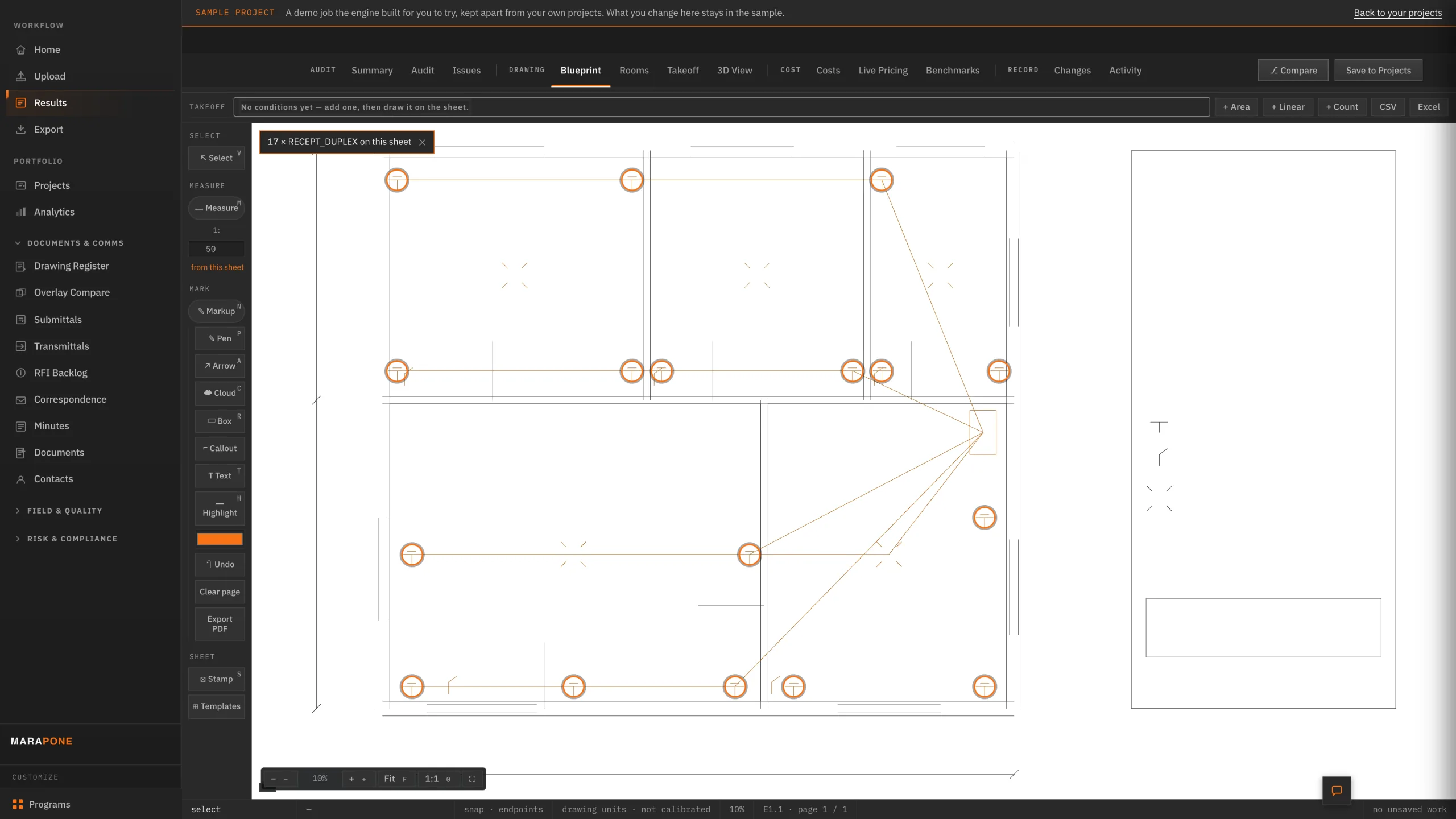
Symbols on the sheet 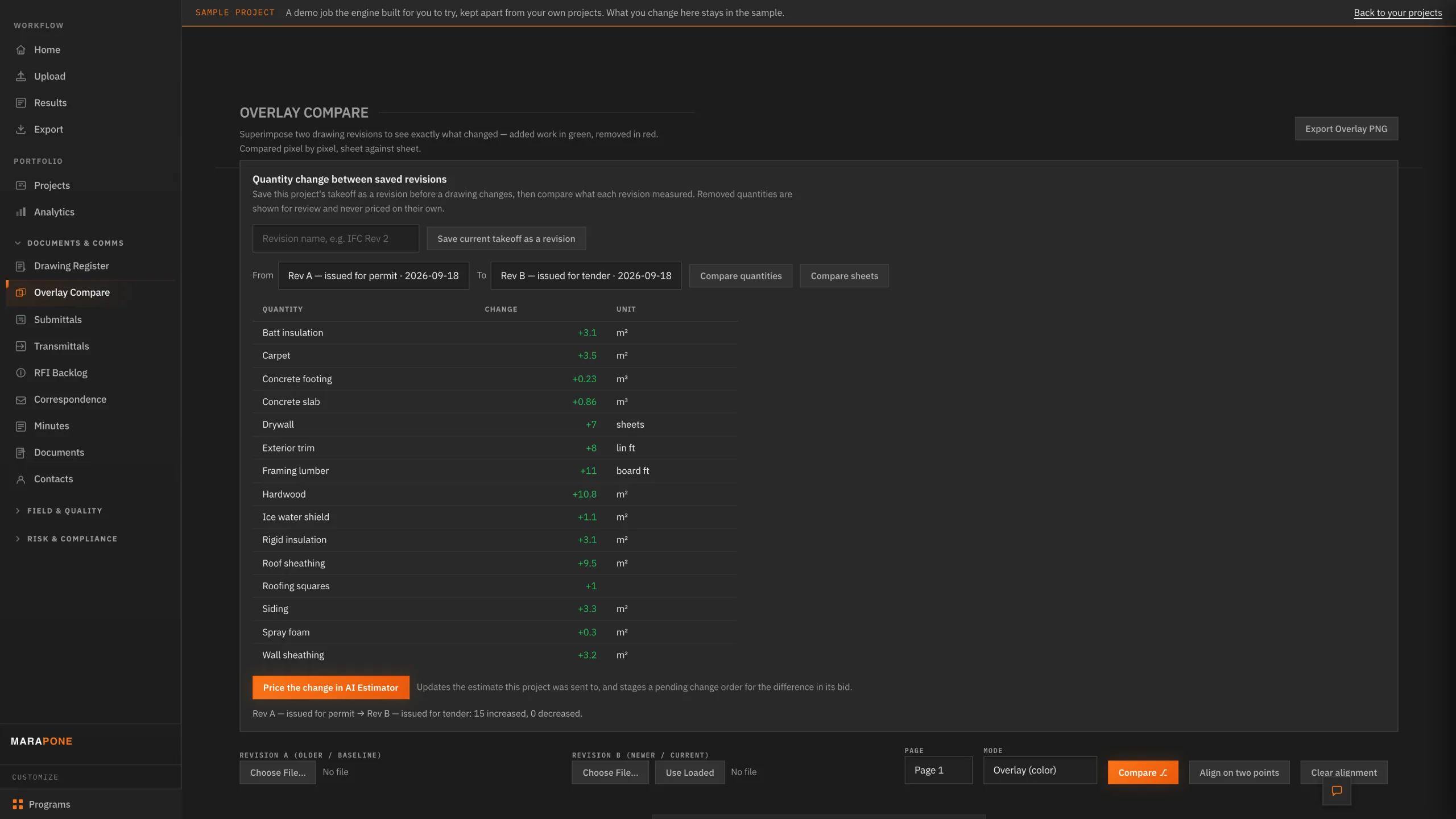
Revision changes 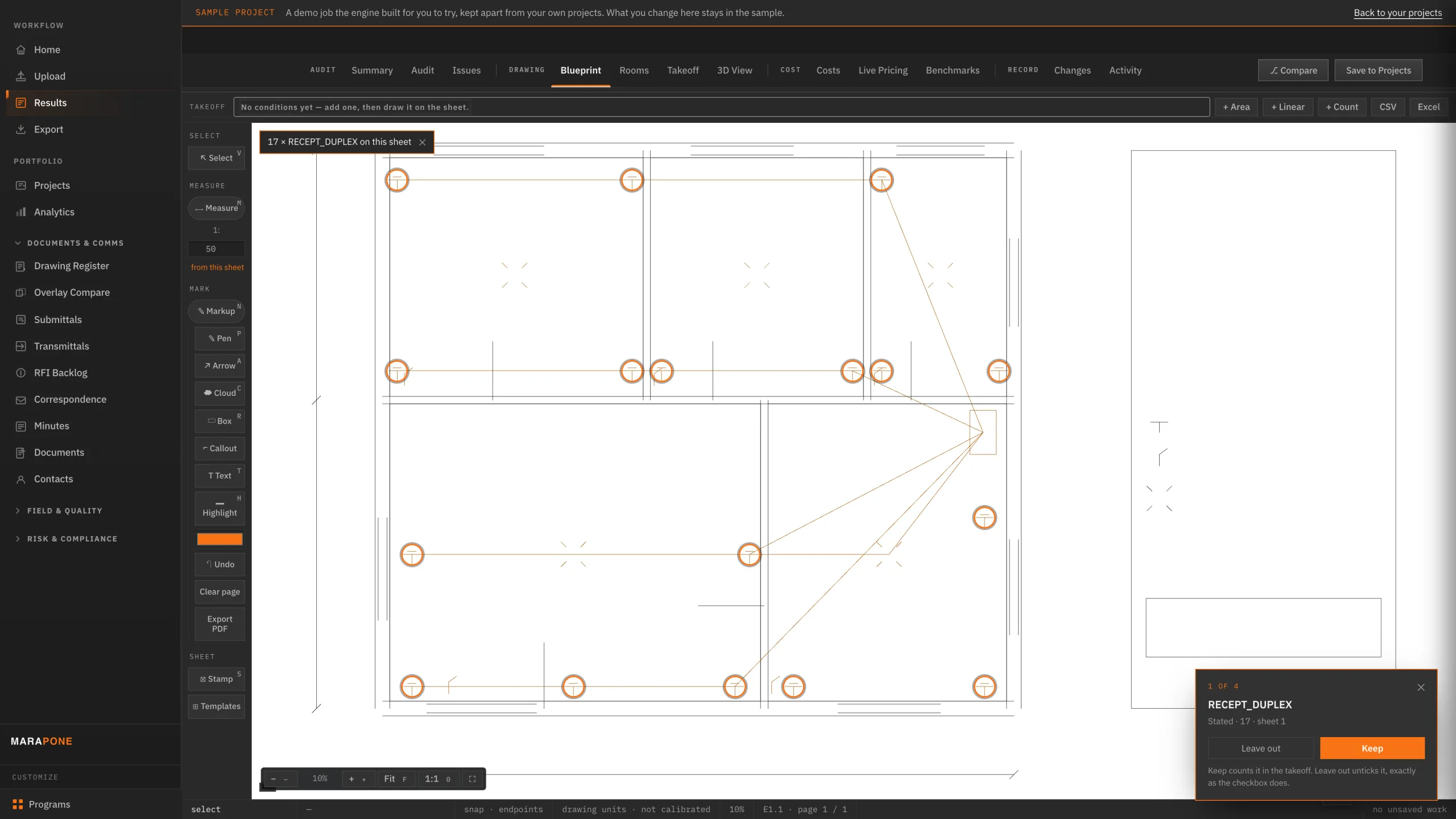
Guided review 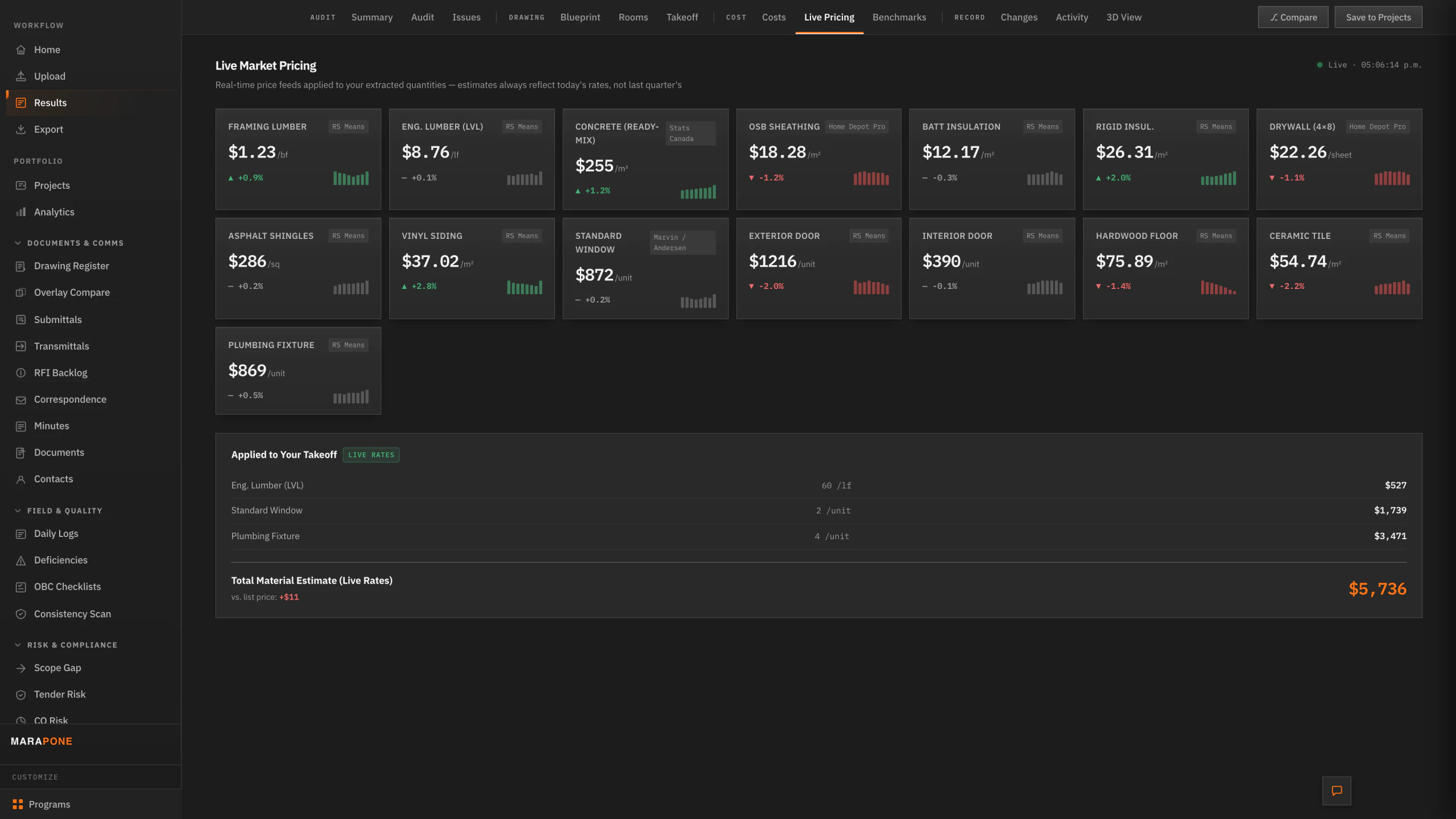
Live pricing
SpecCheckerTwo contract documents. One of them is wrong.Included from Crew, $299 CAD/month
- Measurable properties compared
- 27
- Measurable properties compared
- Named assemblies, 25 CSI divisions
- 39
- Named assemblies, 25 CSI divisions
- Conflict types, including self-contradiction
- 11
- Conflict types, including self-contradiction
Both sides, read into the same shape
A clause in a manual and a cell in a door schedule are the same fact wearing different clothes. So both are normalised into one structure — a single measurable property, of one named assembly, in one canonical unit, carrying the page or sheet it came from. Everything downstream operates on those, which is what makes the comparison possible at all.
Where both documents state a value for the same property and the values disagree, that is a finding: both statements, both citations, and the exact wording each document used. Fire-resistance ratings, gypsum thickness and core type, concrete strength, steel grades, R-values and U-values, SHGC, airflow, filter efficiency, sprinkler design density, interrupting ratings, glazing make-up, hardware grade, warranty terms.
The conflicts a document has with itself
The obvious check is manual against drawings. Two of the eleven conflict types are stranger and more common than anyone expects: a manual written by three people over two years that contradicts itself, and an old general note on one sheet that the revised note on another sheet was supposed to replace.
There is no precedence rule to fall back on inside a single document, which is exactly why those have to be asked rather than resolved. It also catches addenda that were never carried through — the two-page PDF that arrives by email during tender and changes one number while the manual and the drawings both keep saying the old thing — and cross-references to sections that were cut.
Silence looks exactly like agreement
The audit can only report a conflict where both documents say something about the same property. Where the drawings are silent there is nothing to disagree with, and on a findings list that is indistinguishable from the two documents matching. A tool that hid this would be quietly worse than no tool, because a short list reads as reassurance.
So coverage is a first-class screen, not a footnote: what was checked, what could not be read confidently, and where the silence is. Findings are then sorted by what stops a material order today rather than by how many there are, and one click drafts the RFI — one letter per spec section, quoting both documents and asking which governs, because deciding that is the consultant of record's job and not the software's.
Coverage Documents cross-checked Intelligence Conflicts by severity 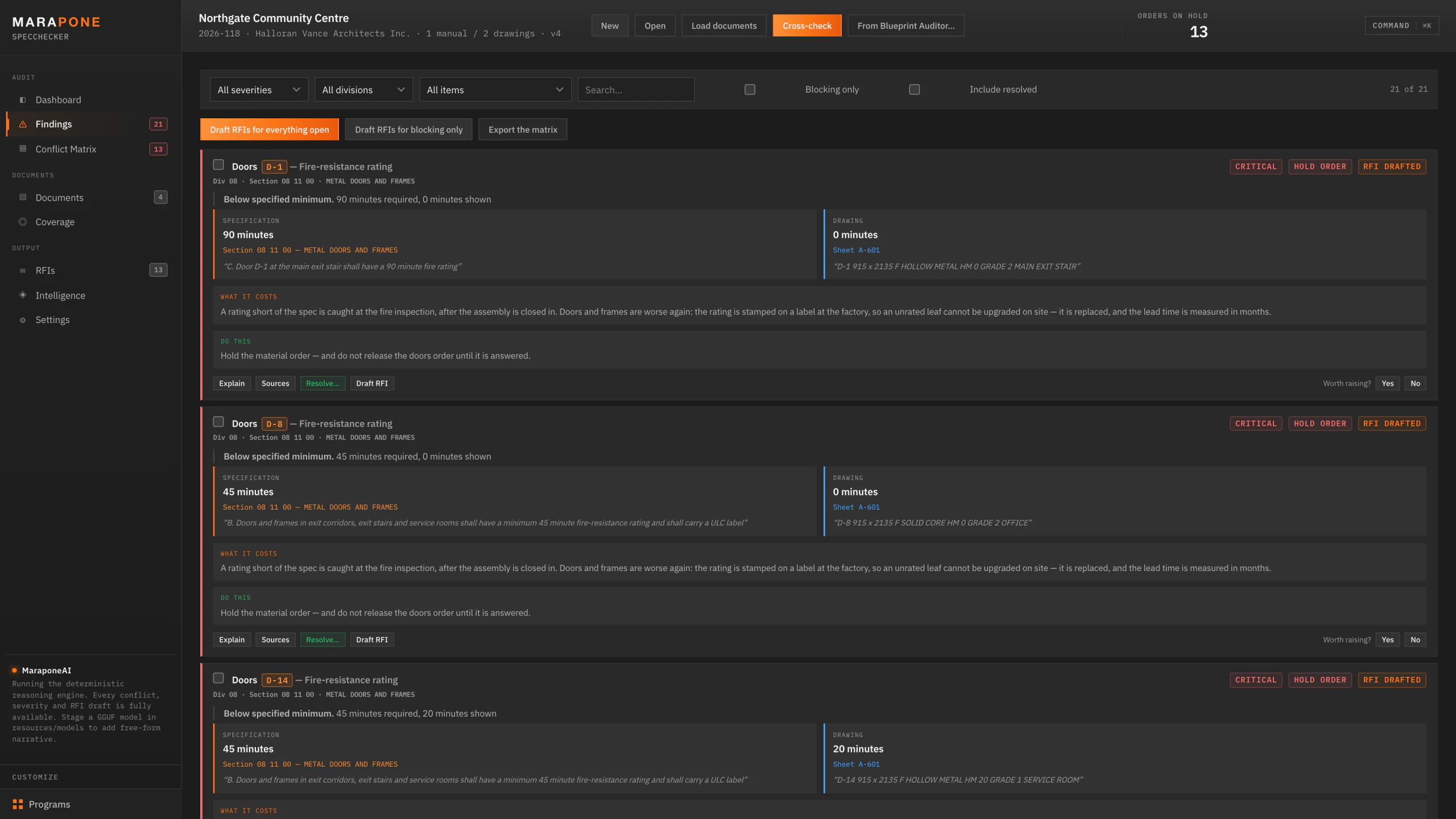
A conflict in full 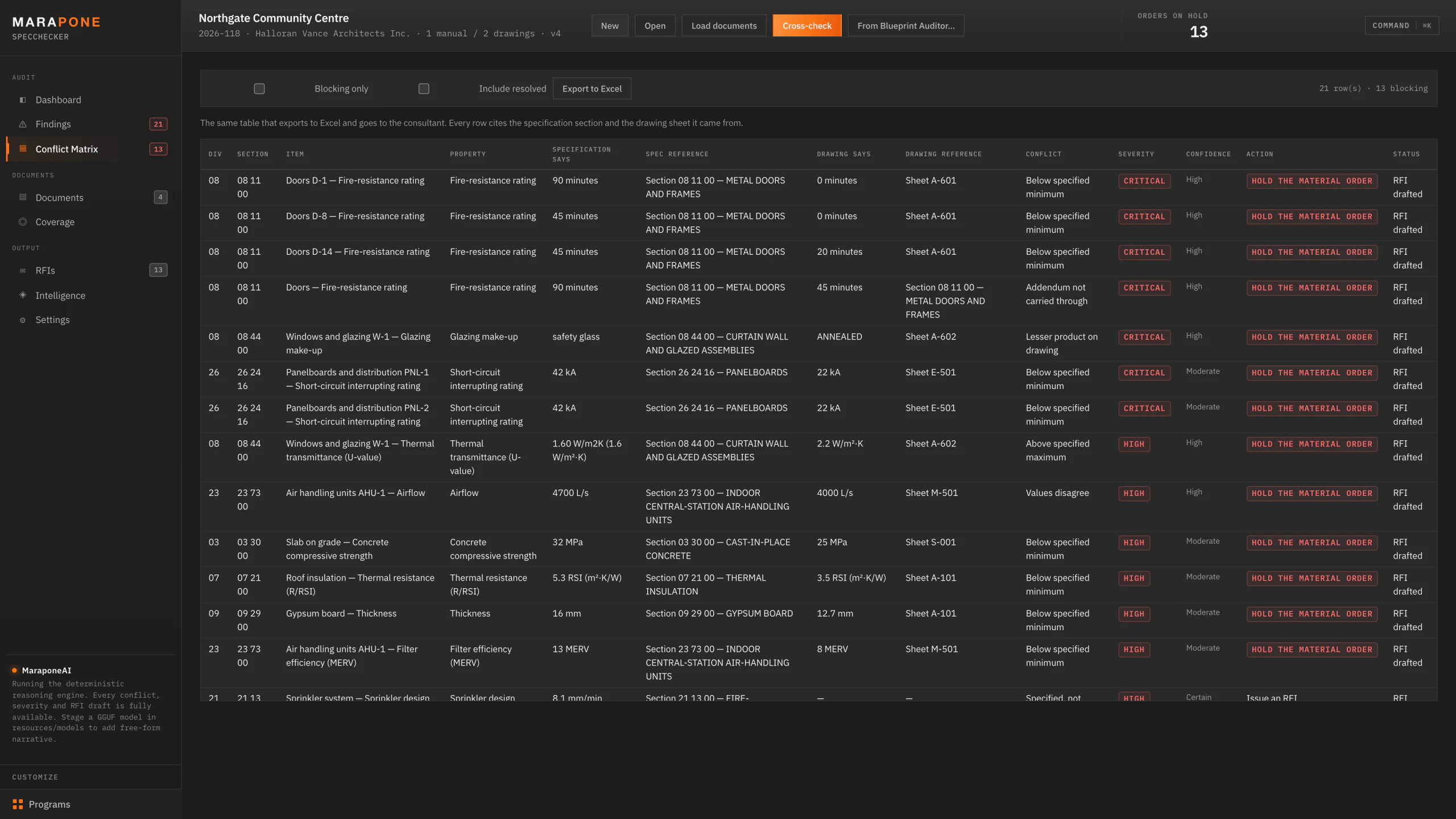
Conflict matrix 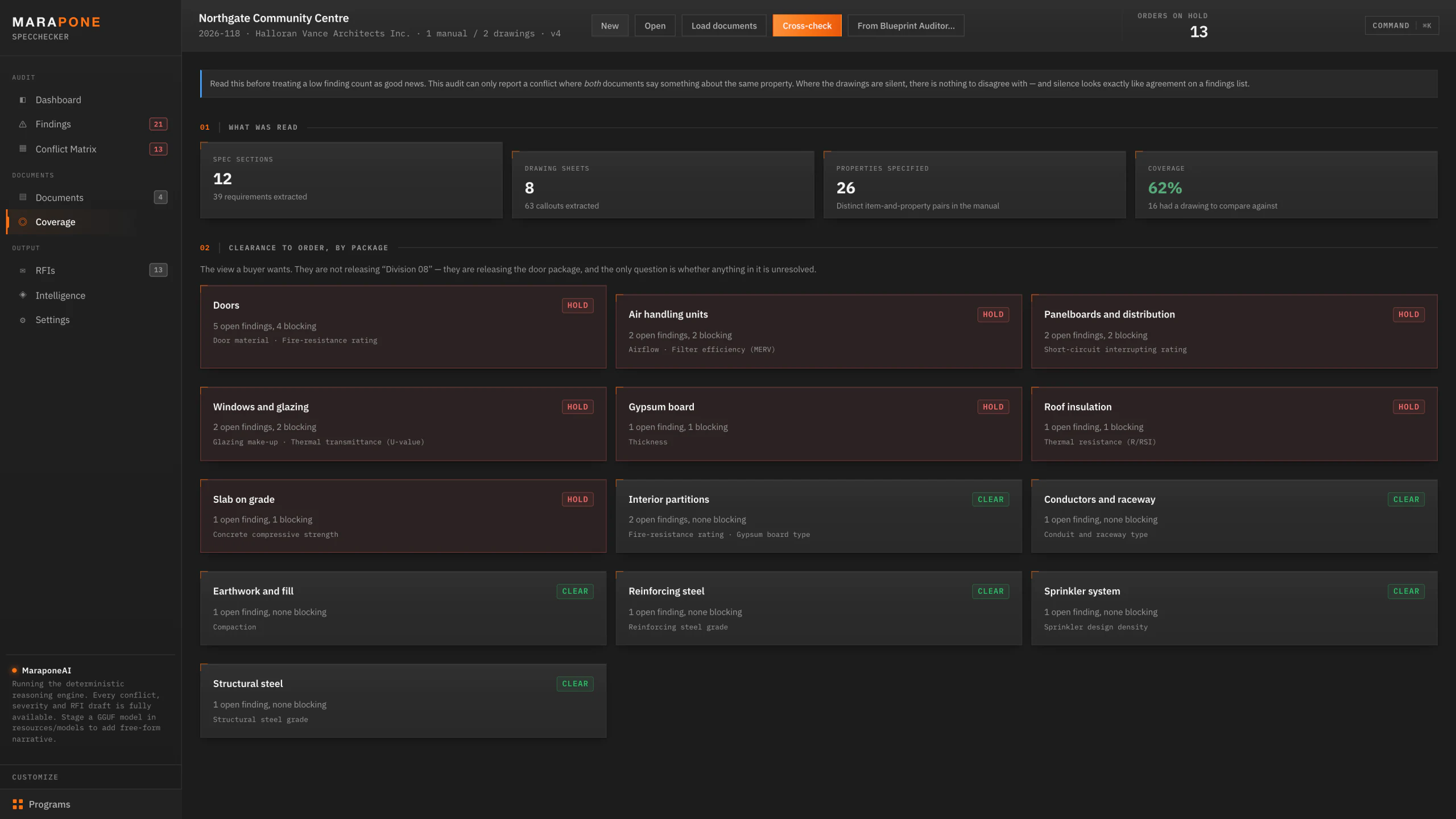
Coverage 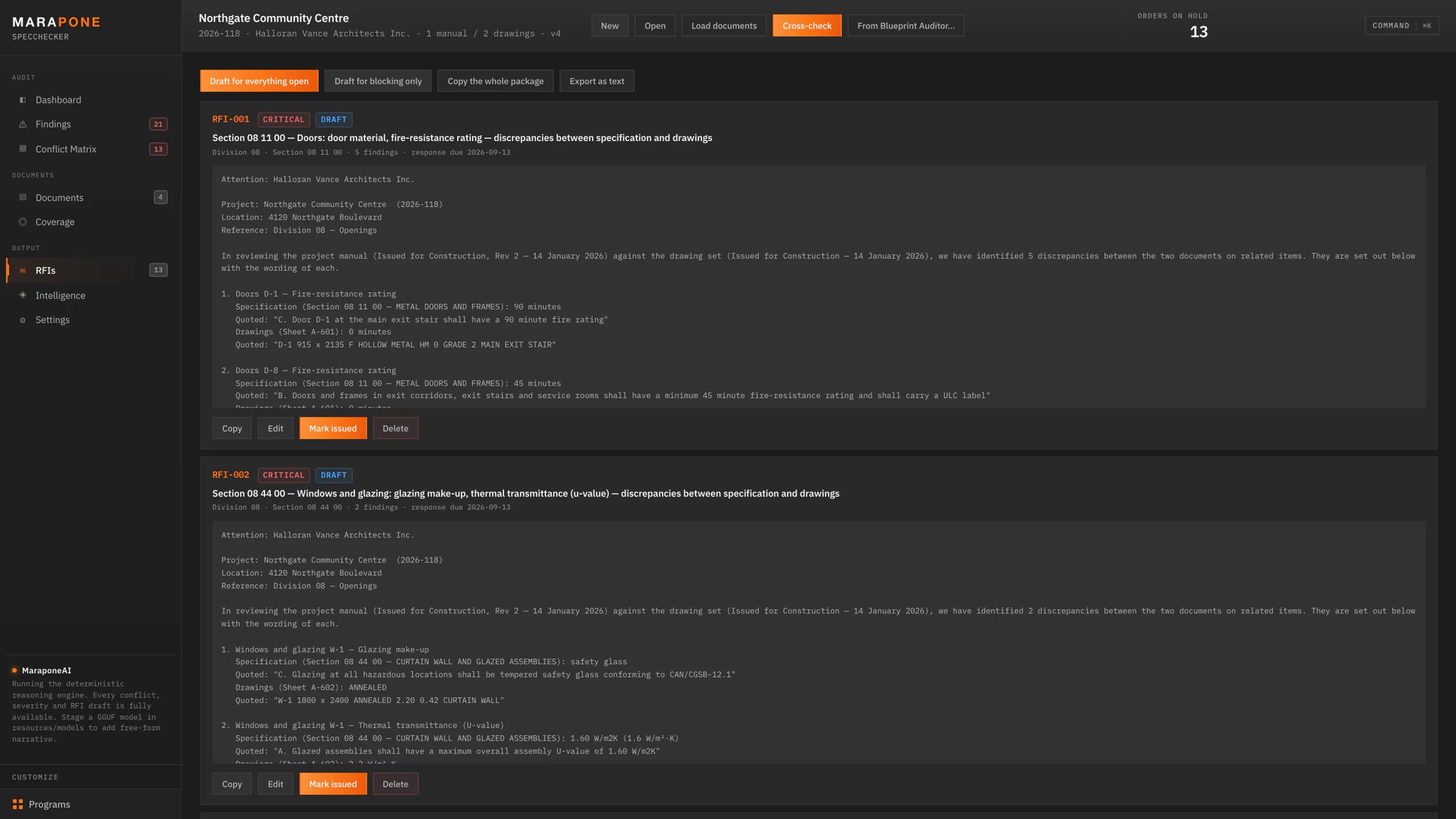
Drafted RFIs
AI EstimatorFrom measured quantities to a number you can stand behind.Included from Solo, $69 CAD/month — the way in to the suite
- Assemblies across 20 CSI divisions
- 57
- Assemblies across 20 CSI divisions
- Risk rules behind the contingency
- 27
- Risk rules behind the contingency
- CAD/month, the way in to the suite
- $69
- CAD/month, the way in to the suite
Your rates come first
Every estimating tool that leads with its own cost catalogue eventually gets ignored, because the estimator already knows what their drywall sub charges. So the rate sheet you import is the primary source, always. The bundled Toronto catalogue fills the gaps, validates what you brought, and drives contingency where your data is thin — it never overrules a number you know to be true.
Feed in completed jobs and it goes further: catalogue defaults get replaced by your crews' measured productivity and cost variance, weighted by how much history it actually has.
The soft costs nobody models
On a Toronto residential project the development charge routinely exceeds the entire finishes package, and it is the line most often carried as a guess. The estimator models it properly — permits on the current fee schedule with surcharges, DCs gross and reduced, parkland, the Community Benefits Charge, HST and the new housing rebate.
Municipal schedules change every year, so every figure is editable in the app, and the jurisdiction it prices against is a data pack rather than a hardcoded assumption — tell it which province, state or country you build in and the rates, tax, holdback and code rules follow. Corrections reach every subscriber the day they ship, with no version to buy.
A number with a reason attached
Twenty-seven risk rules produce a recommended contingency, each with a written reason and a mitigation rather than a single opaque percentage. On top sits what-if scenarios, tornado sensitivity, and a Monte Carlo distribution that answers the only question that matters — what is the chance this job loses money.
The bid strategy layer closes it out: a margin ladder with win probability drawn from the firm's own recorded outcomes, an expected-value optimum, a risk-adjusted floor and a walk-away number.
Estimate dashboard 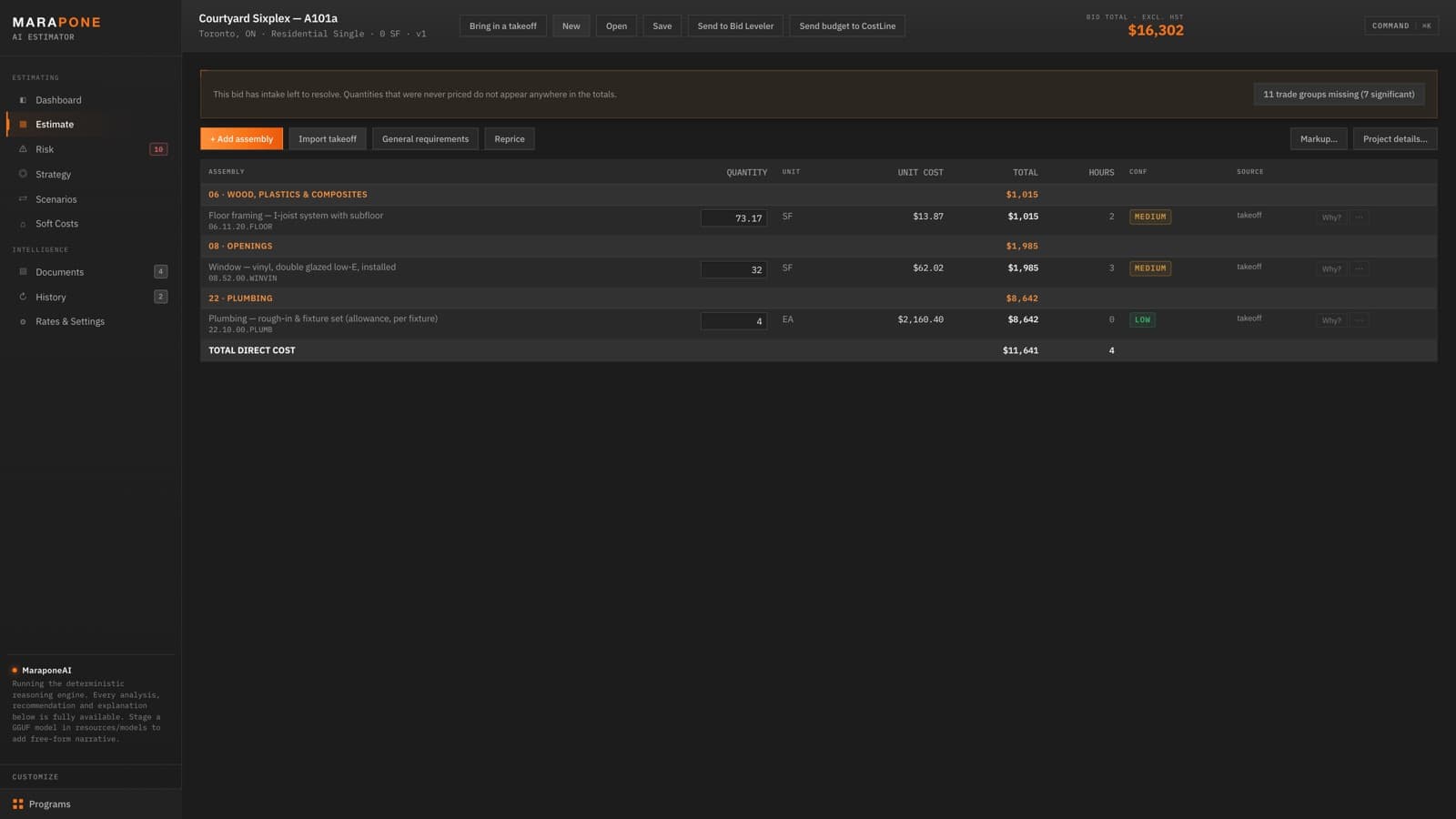
Estimate 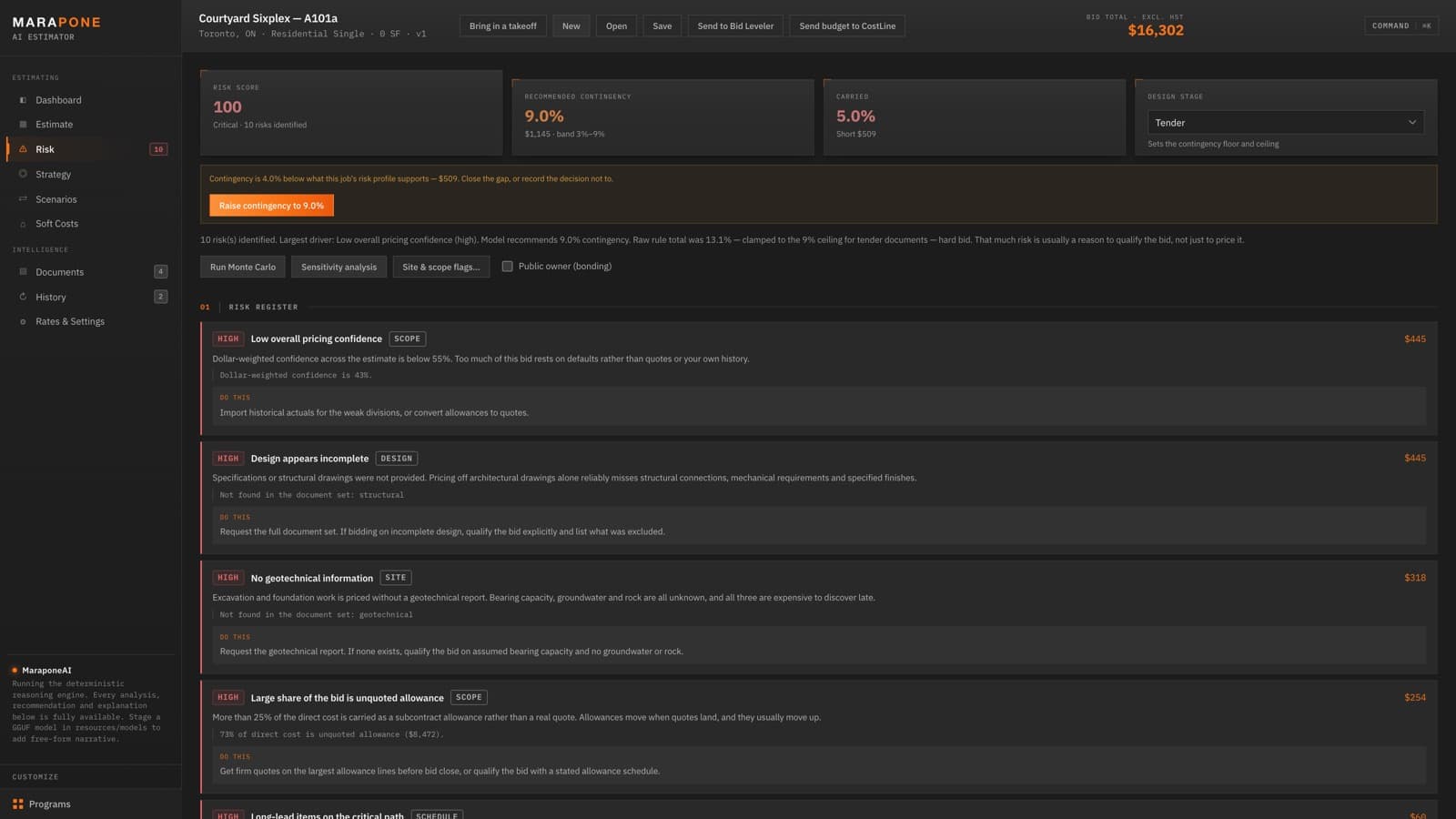
Risk register 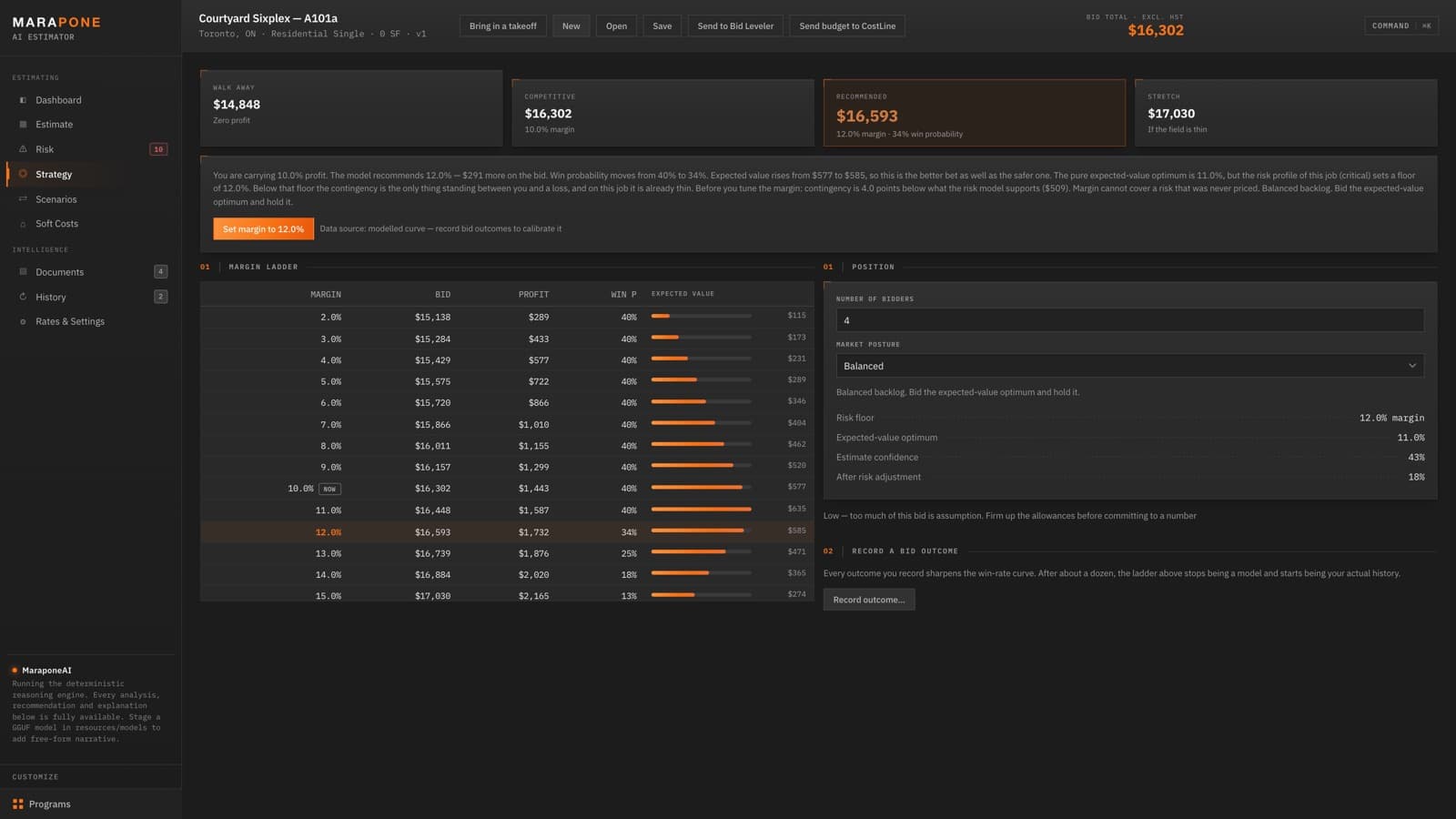
Bid strategy 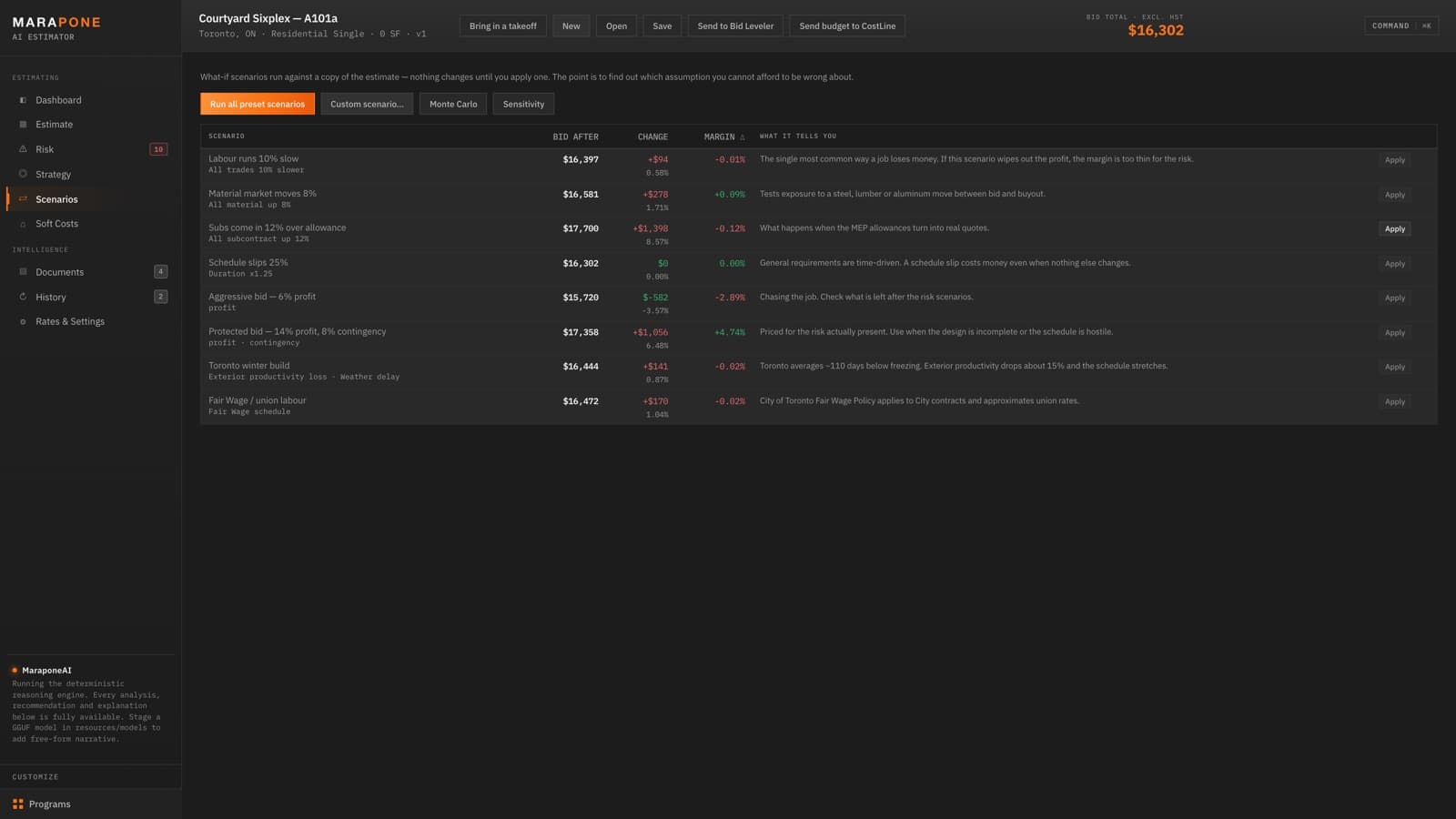
What-if scenarios 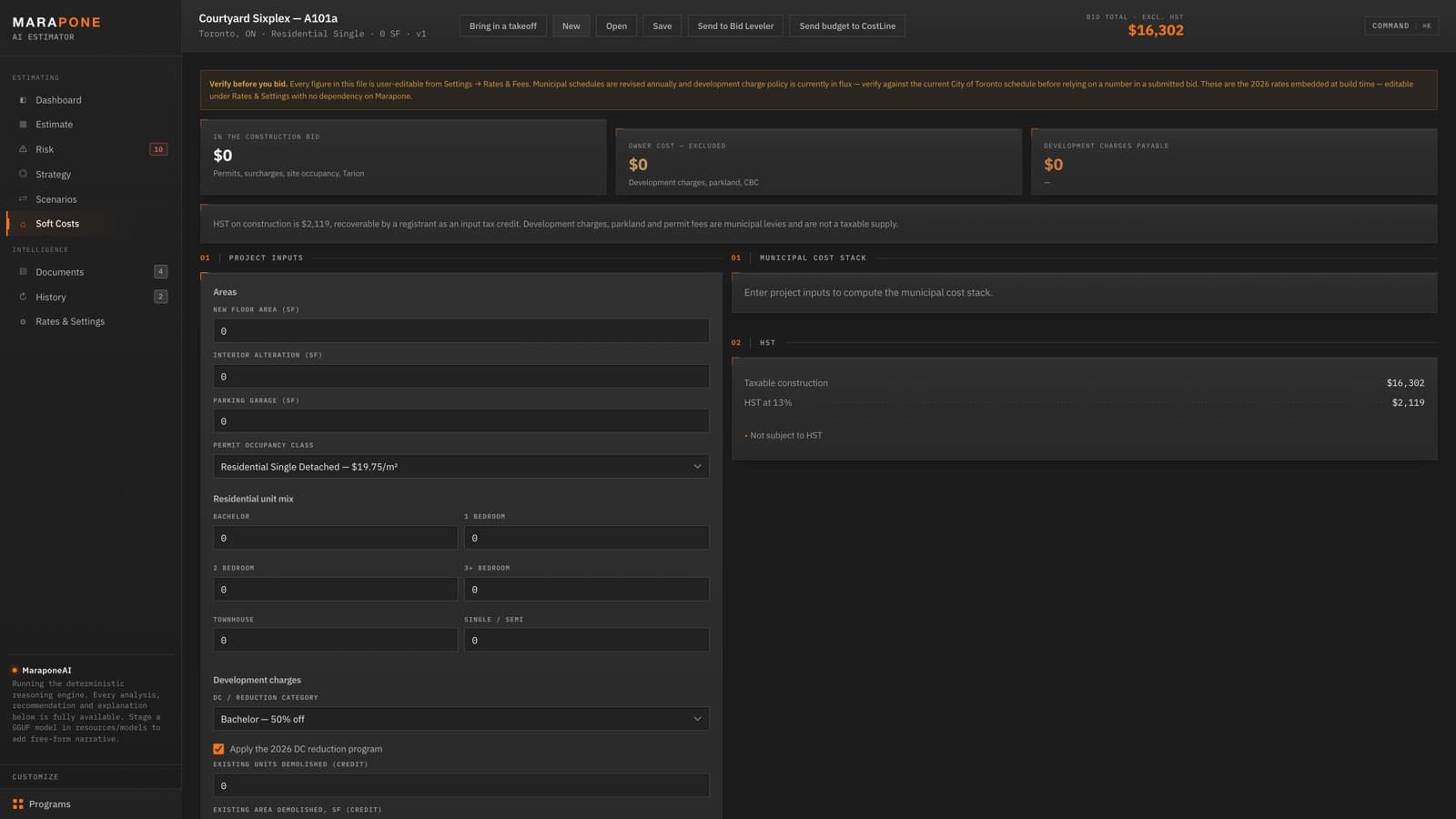
Soft costs
Bid LevelerThe lowest number is not the lowest bid.Included from Pro, $499 CAD/month
- Scope elements across 15 trade packages
- 155
- Scope elements across 15 trade packages
- Valuation bases, ranked by strength
- 6
- Valuation bases, ranked by strength
- Finding types, from gaps to outliers
- 9
- Finding types, from gaps to outliers
The bid set prices its own gaps
The interesting move here isn't reading a PDF. It's this: when Sub A excludes crane hoisting and Sub B carries it as a $15,000 alternate, Sub A's gap is worth $15,000. That's a real market price — for this project, this schedule, this site, from a contractor who wants the work. Not a number from a book, and not a percentage.
So the levelling pass looks for competitor evidence first and only falls back to a local rate table for elements nobody priced. Every adjustment states which basis it used, ranked openly from strongest to weakest: priced by a competing bidder, the bidder's own alternate, your award history, the rate table, a percentage of trade value, or a figure the estimator typed. An estimator who can't say where a number came from can't use it in a negotiation, so the weakest bases are labelled as such rather than blended into a total.
Silence is the expensive part
An exclusion is on the record and can be priced. Silence is what reaches site unresolved, months later, with no competitive tension left — so the two are levelled the same way and flagged differently.
Around that sit the other findings: scope every bidder left out, which doesn't change who is cheapest but does change what the trade costs; allowances wearing a price tag; commercial mismatches like HST in or out, bonding, escalation and validity that expires before award; addenda nobody carried, which makes a bid a price for a different project; price-moving qualifications quoted back with the reason each one matters; and outliers still well below the field after levelling, which in this market is rarely a bargain.
It produces the day you were about to spend
The output is the levelling matrix as an Excel workbook — scope down the side, bidders across the top, five sheets, live formulas so an override moves the totals — plus an award recommendation written to be read by a PM who wasn't in the meeting, and one clarification letter per bidder with the reason each open item is being asked.
It also writes the subcontract scope paragraphs from the levelled position, so what levelling added back can't be quietly re-excluded after signing, and hands its numbers on: JSON to the AI Estimator, CSV to ScopeGuard, a Procore-shaped bid tab for everything else. On the demo package the low bid was $1,142,000; levelled, that bidder isn't the cheapest, and awarding on the bid form alone would have cost $84,986.
The levelling matrix Quotes as received Award recommendation Bid board 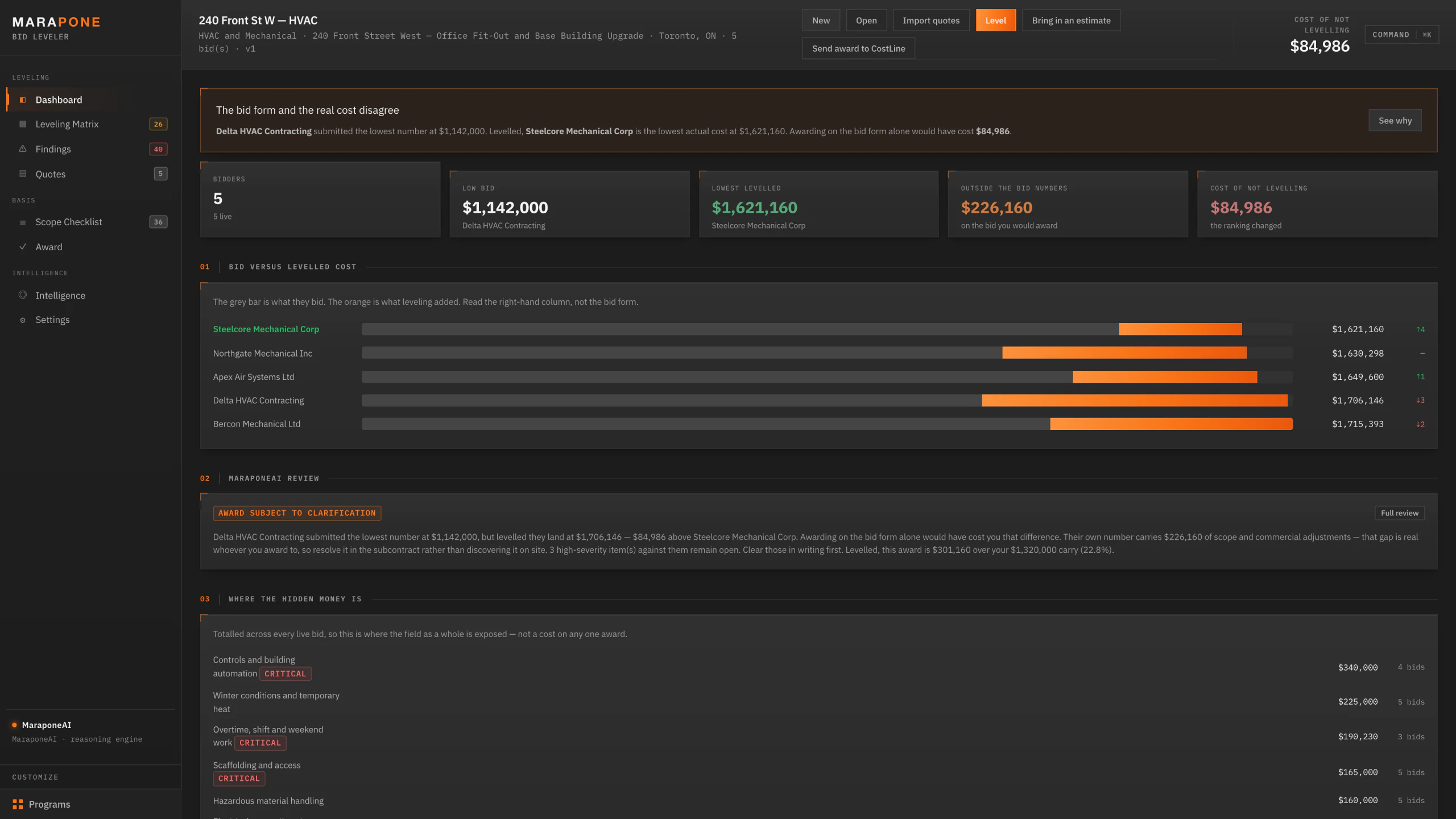
Every bid, levelled 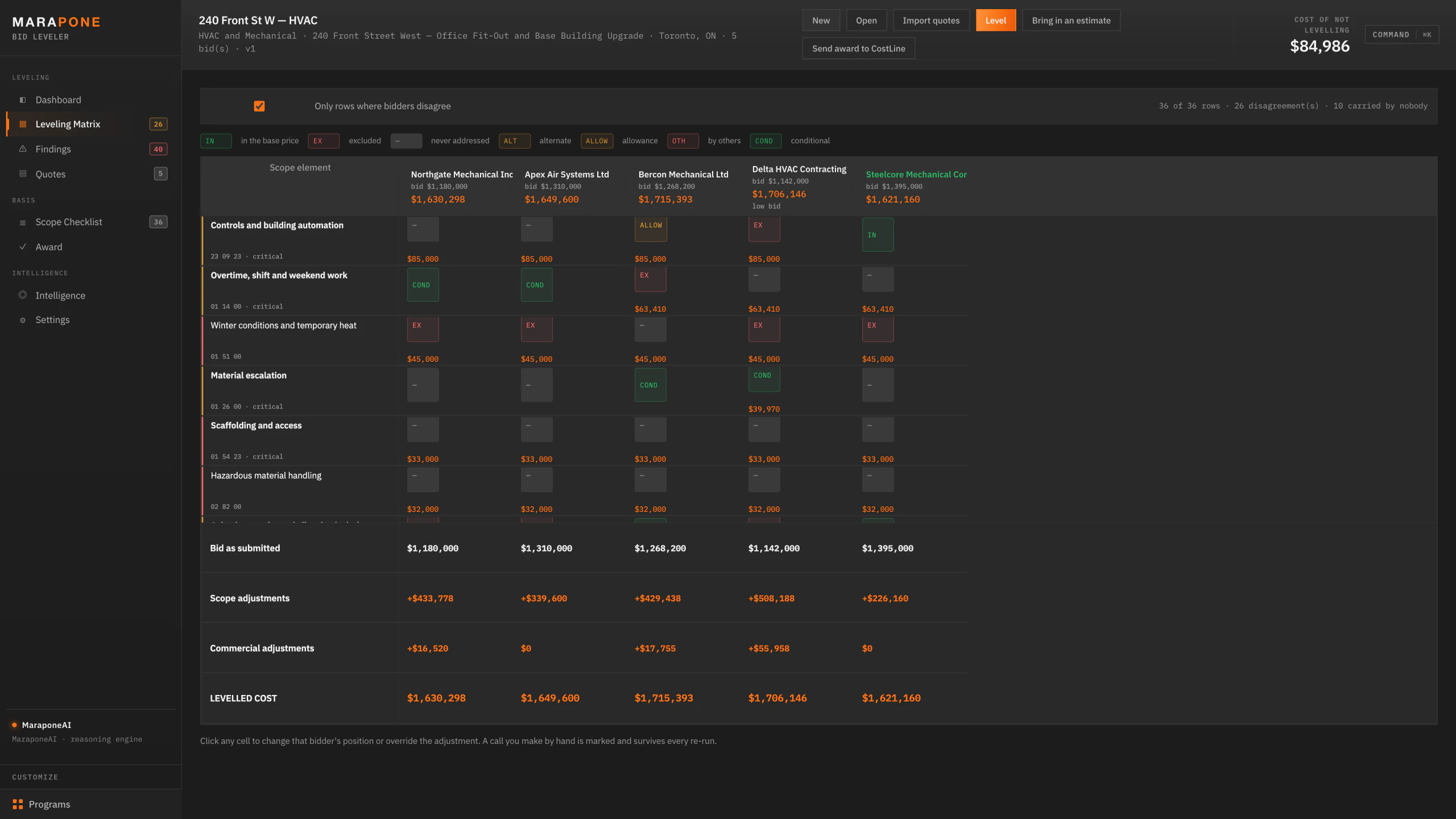
Levelling matrix 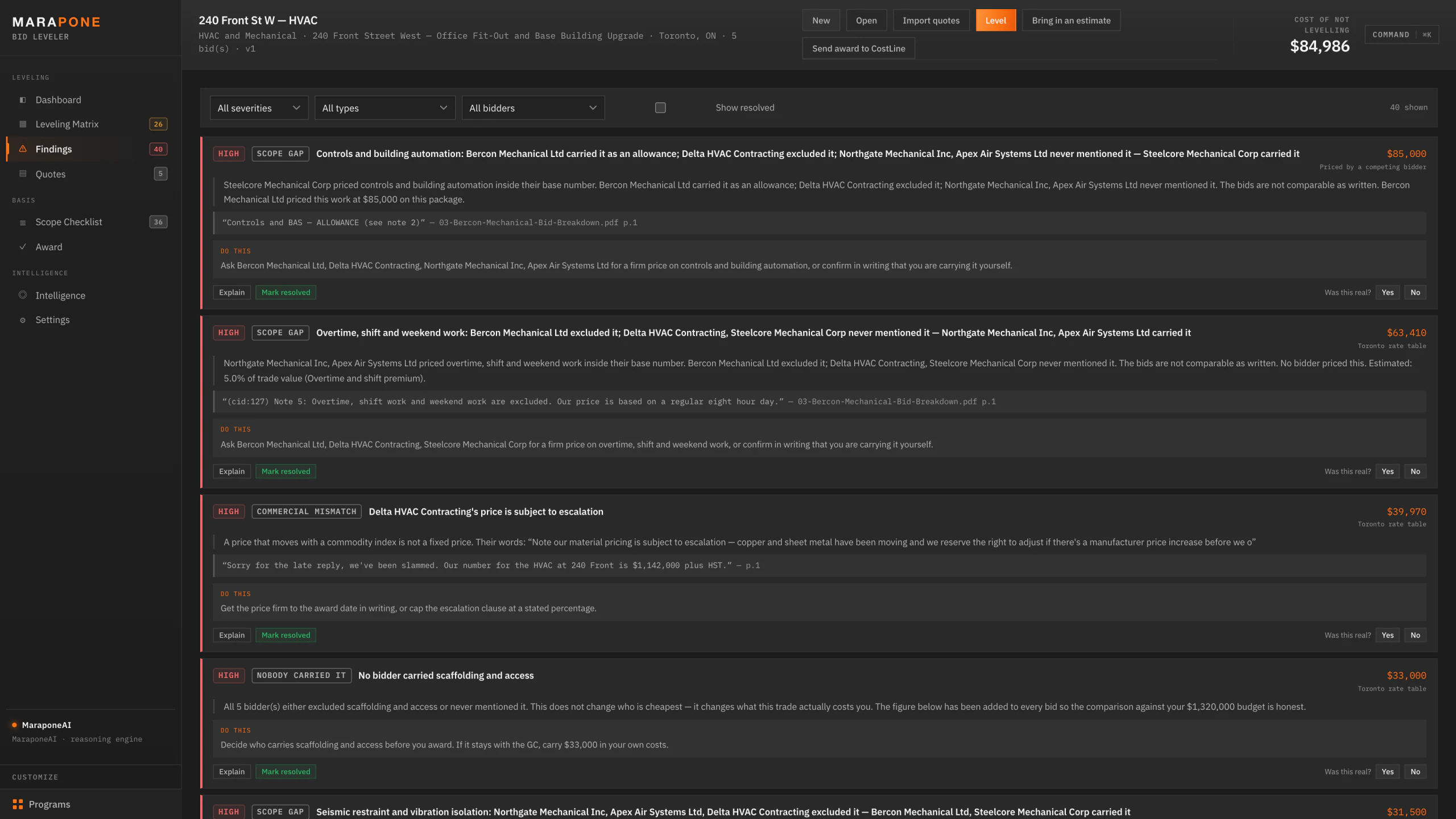
What each bidder left out 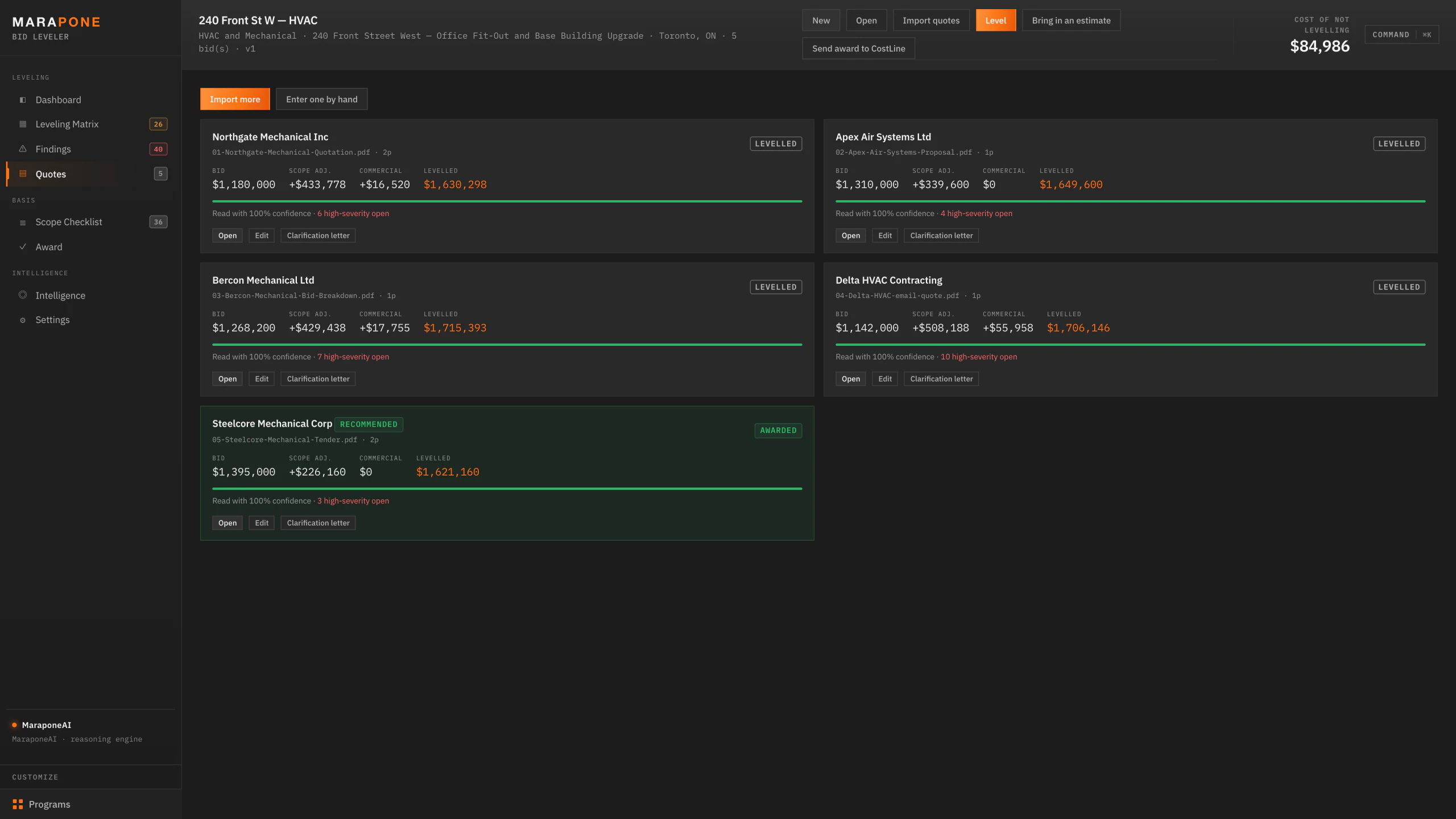
Quotes as received 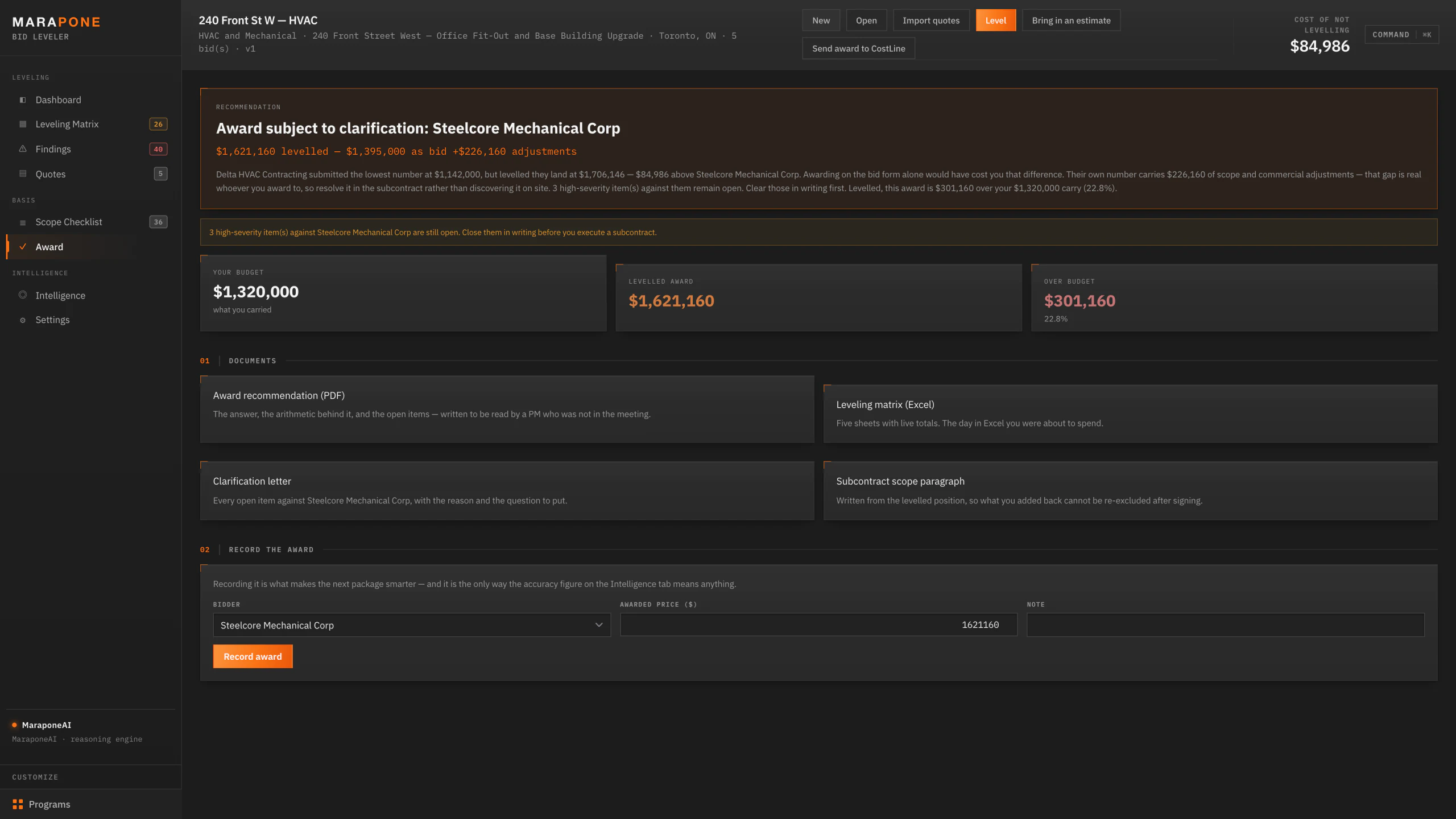
Award recommendation
ScopeGuardThe scope gaps in a buyout, found before award.Included from Crew, $299 CAD/month
- Classes of finding, each with a citation
- 8
- Classes of finding, each with a citation
- Trade packages modelled
- 20
- Trade packages modelled
- CAD/month, on the Crew plan
- $299
- CAD/month, on the Crew plan
Reading exclusions, not just inclusions
The commercially dangerous sentence in a subcontractor proposal is almost never a line item. It is a clause: “excludes winter concreting” on a structure running November to March, or “fire alarm verification by others” on work that cannot be occupied without it.
The engine reads the master documents and every proposal, then cross-references them — missing scope, required scope explicitly excluded, double coverage between trades, interface grey zones, unusable pricing, and addenda that were never acknowledged.
Every finding is citable
A finding nobody can check is worse than no finding, because it costs an estimator an hour to disprove. So each one carries a plain-language explanation, a citation on both sides — the clause in the master documents and the page and line in the sub's letter — a confidence score, and a cost exposure range with its stated basis.
That structure is what makes the output usable in a buyout meeting rather than just interesting.
Proven on a real package
The app ships with a full Toronto buyout — a project manual, three addenda and fourteen real subcontractor proposals — that runs through the same reader, extractor and cross-reference engine a customer's own documents go through. Nothing about the demo is canned.
On that package it finds, among other things, an excluded fire pump that explains why the sprinkler price looks sharp, an air-barrier tie-in that both the glazing and envelope trades excluded, firestopping that nobody carried at all, and four proposals that never acknowledged Addendum 3.
Comparing trades Documents Scopes Dashboard 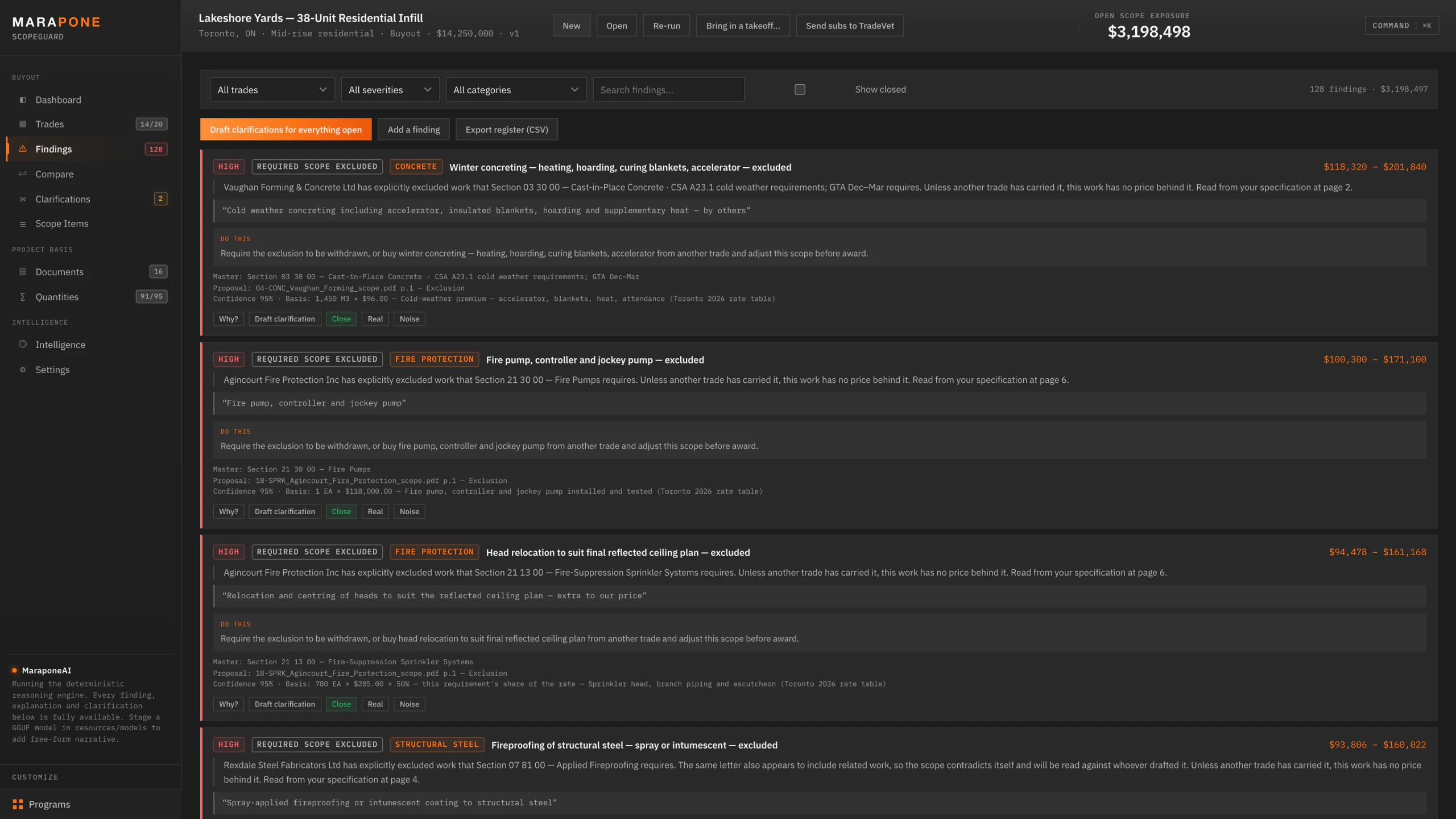
Findings 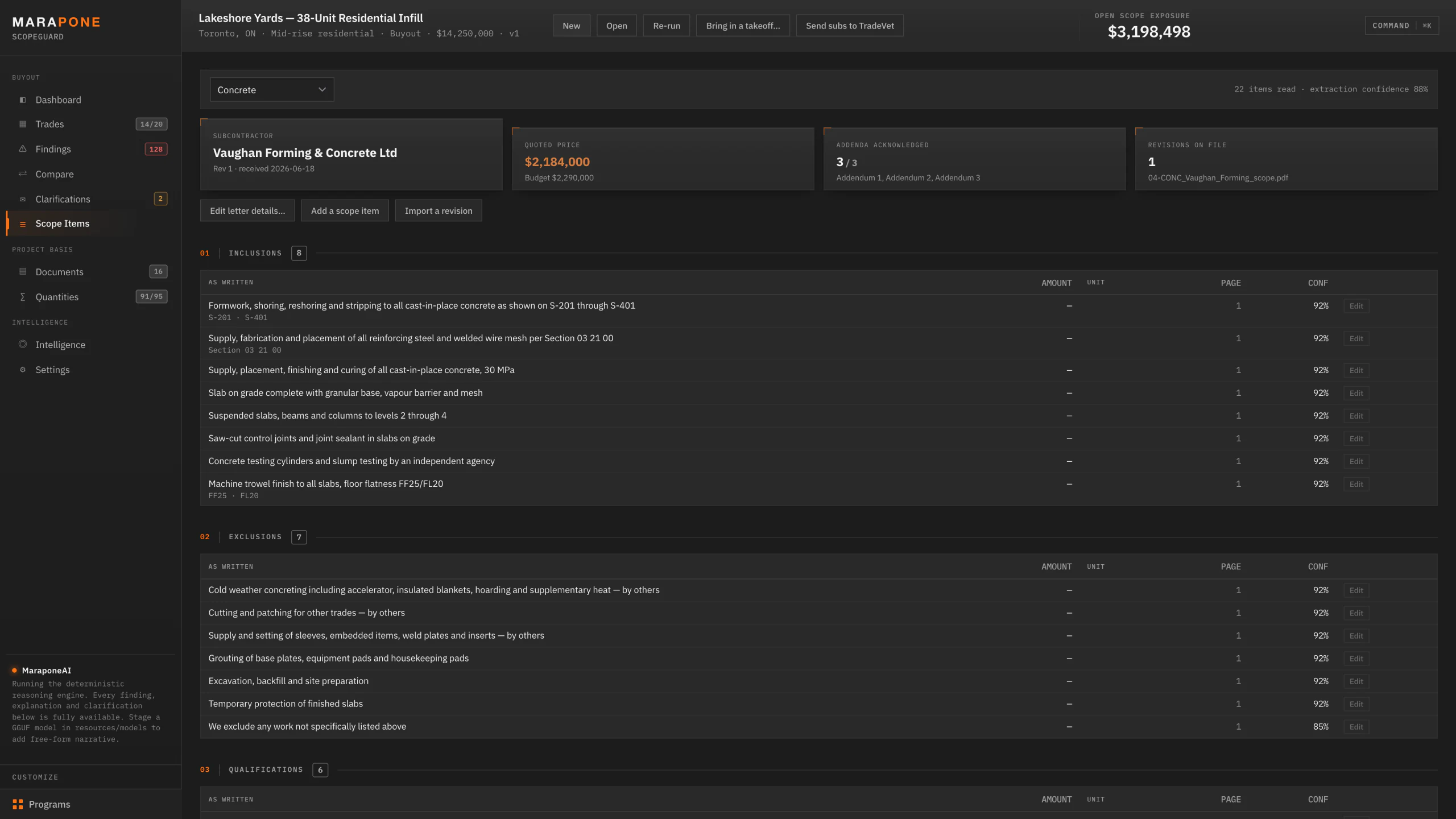
Scopes 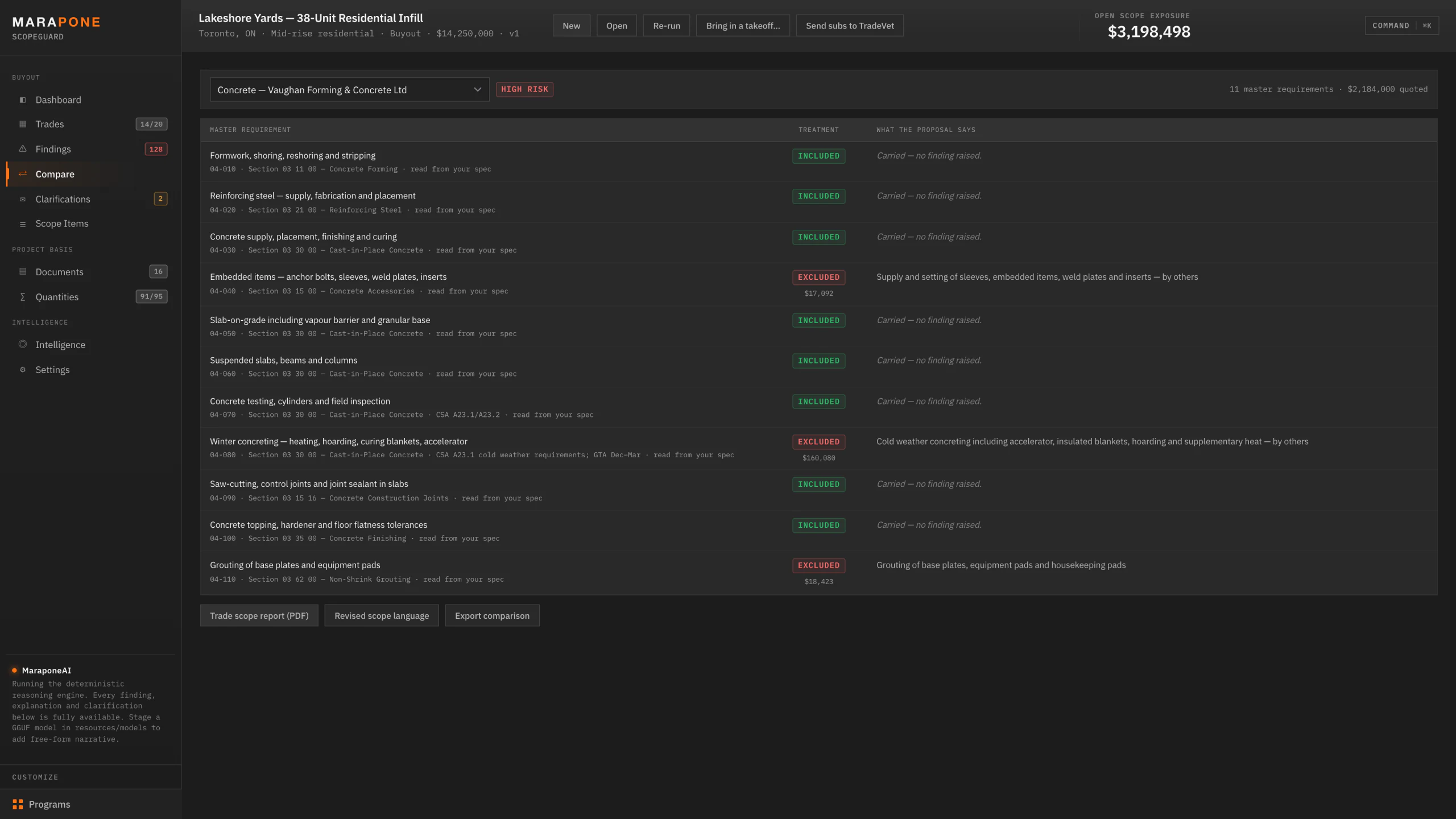
Trade comparison 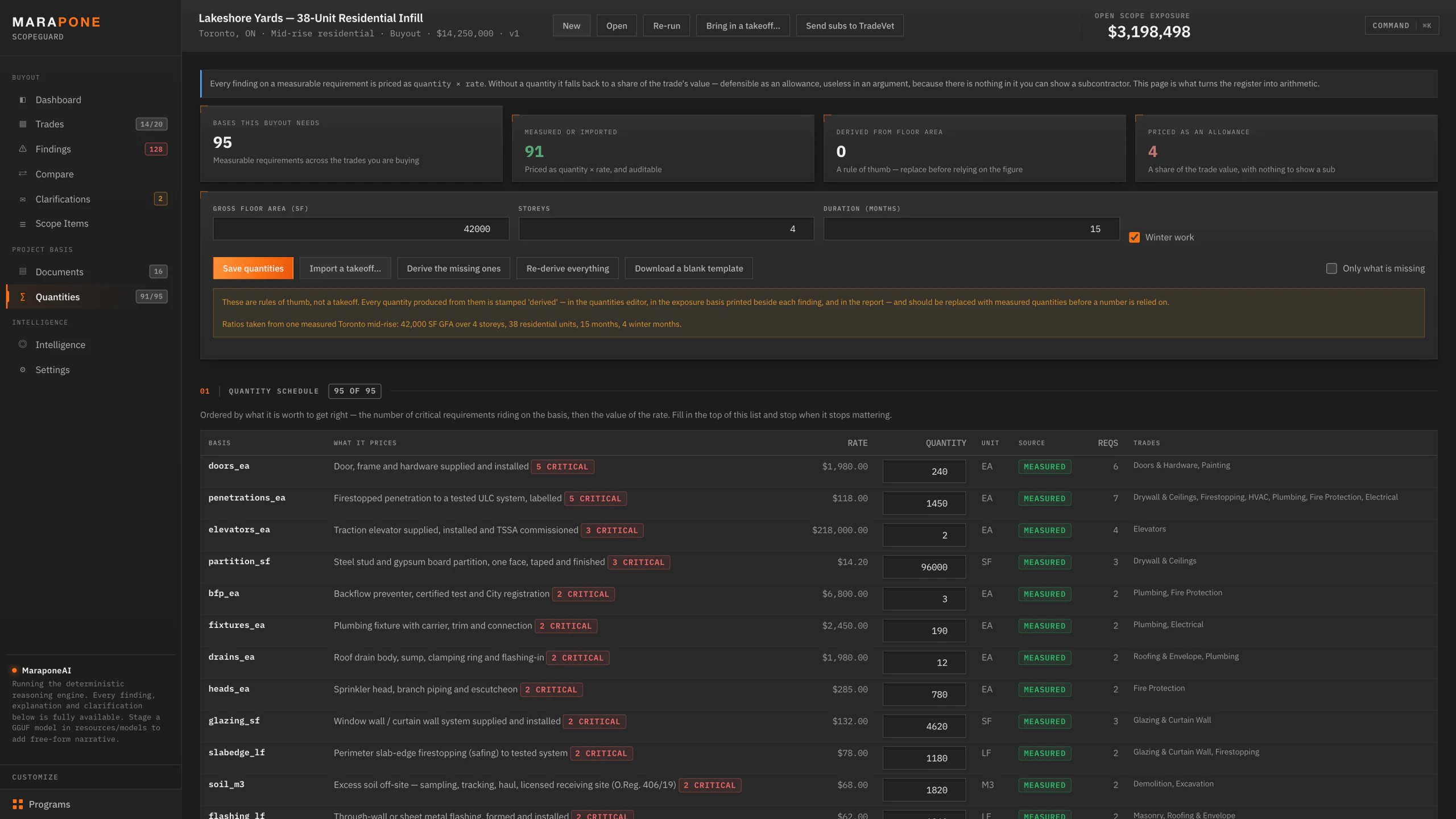
Quantities
On site, in the pocket
iOS + Android · Q4 2026, included in every plan
The programs live where the documents do, but half the work happens on site — hands full, no desk. The mobile app closes that gap: scan a plan, check an audit finding, pull up the estimate from the phone already in the superintendent's pocket.
It is the same account and the same workspace as the browser, included in every plan with nothing extra to buy — a subscription covers both at once, and there is no second mobile bill. Native on iOS and Android.
Private LLM, Python, Web app, Swift, iOS / iPadOS, Android, Computer vision